L-Pyroglutamic Acid → HCID 14053691, compound
Reaction equation

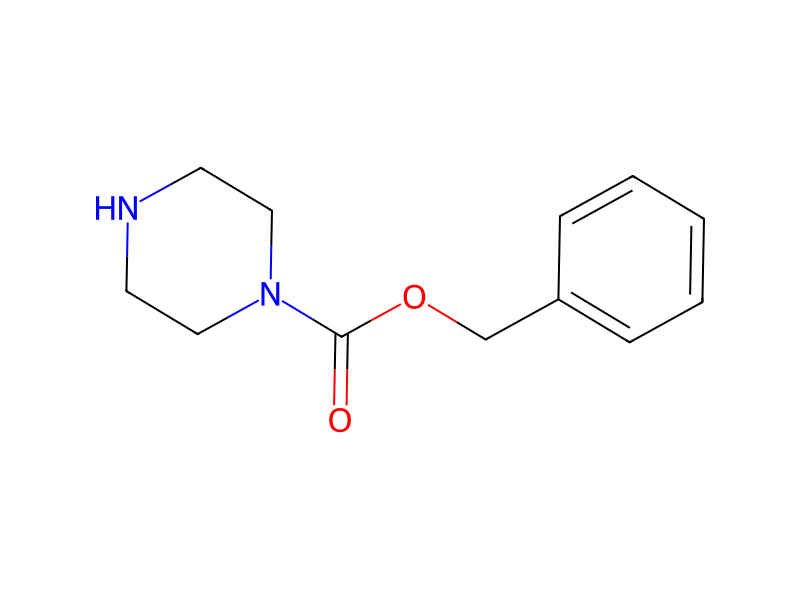
[NH:1]1[C:5](=[O:6])[CH2:4][CH2:3][C@H:2]1[C:7]([OH:9])=O.[C:10]([N:20]1[CH2:25][CH2:24][NH:23][CH2:22][CH2:21]1)([O:12][CH2:13][C:14]1[CH:19]=[CH:18][CH:17]=[CH:16][CH:15]=1)=[O:11].C1(N=C=NC2CCCCC2)CCCCC1>C(#N)C>[C:10]([N:20]1[CH2:21][CH2:22][N:23]([C:7]([CH:2]2[NH:1][C:5](=[O:6])[CH2:4][CH2:3]2)=[O:9])[CH2:24][CH2:25]1)([O:12][CH2:13][C:14]1[CH:15]=[CH:16][CH:17]=[CH:18][CH:19]=1)=[O:11]Participants
Reactant 3


Product 1

Reagents, catalysts & solvents 1

Procedure
Pyroglutamic acid (112.4 g), 147.7 g of N-carbobenzoxypiperazine, 179.7 g of dicyclohexylcarbodiimide and 6.7 liters of acetonitrile were heated to reflux for 6 hours with stirring. The insoluble matters were removed by filtering the reaction mixture and the solvent was evaporated from the filtrate in vacuo. The residue was subjected to a silica gel column chromatography to give 190 g of oily N-carbobenzoxy-N'-(2-pyrrolidon-5-carbonyl)piperazine. Thirty grams of this was dissolved in 450 ml of methanol and the solution was subjected to a catalytic reduction using 3.0 g of 5% palladium-carbon with stirring at room temperature. The catalyst was removed by filtering the reaction solution and the solvent was evaporated in vacuo from the filtrate to give 20 g of the product. This was recrystallized from a mixture of methanol and ethyl acetate to give 17.5 g of desired compound, m.p. 162°-163° C.
Workup
- temperatureto reflux for 6 hours
- customThe insoluble matters were removed
- filtrationby filtering the reaction mixture
- customthe solvent was evaporated from the filtrate in vacuo
Sources & evidence
- ORD record
- ord-8ebb91f4d5d64a6eab0053ff85d67bb1
- Source dataset
- uspto-grants-1992_04
- Patent number
- US05102882
Reaction notes
Loading…