Dicyclohexylcarbodiimide → N,N'-Dicyclohexylurea
Reaction equation

[CH:1]1([N:7]=[C:8]=[N:9][CH:10]2[CH2:15][CH2:14][CH2:13][CH2:12][CH2:11]2)[CH2:6][CH2:5][CH2:4][CH2:3][CH2:2]1.[OH:16]C(CCCC[C@H]1[C@@H]2[C@@H](NC(N2)=O)CS1)=O>CS(C)=O>[CH:10]1([NH:9][C:8]([NH:7][CH:1]2[CH2:2][CH2:3][CH2:4][CH2:5][CH2:6]2)=[O:16])[CH2:15][CH2:14][CH2:13][CH2:12][CH2:11]1Participants
Reactant 2


Product 1
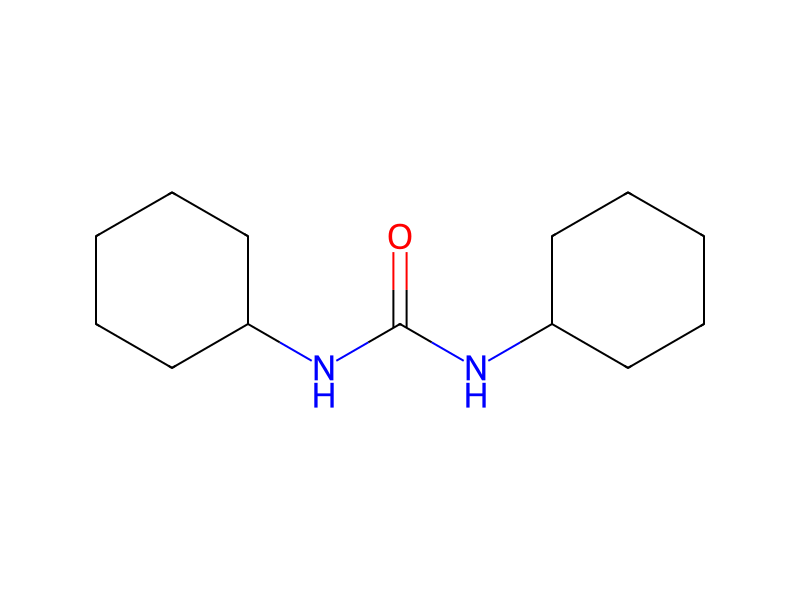
Reagents, catalysts & solvents 1

Procedure
One molar equivalent (1.97 g) of HNSA was mixed together with one molar equivalent (1.85 g) of dicyclohexylcarbodiimide and one molar equivalent (2.0 g) of biotin in 50 ml of dimethylsulfoxide at room temperature overnight. The reaction resulted in the formation of dicyclohexyl urea as a precipitate. The precipitate was filtered off and 400 ml of dichloromethane was added to the mother liquor. After several hours a solid precipitate was formed. The yield of this crude ester was 59% of theoretical. This precipitate was analyzed spectroscopically as described in Example IA and found to contain 38% biotin-HNSA ester together with 68% of free HNSA. The solid was then purified by column chromatography on LH20 Sephadex in DMF and positively identified as described above for the preparation of mal-sac HNSA ester. The purification yielded biotin-HNSA ester of greater than 99% purity.
Sources & evidence
- ORD record
- ord-2b93251e199d47048fcc62ff3a5c887c
- Source dataset
- uspto-grants-1990_09
- Patent number
- US04954637
Reaction notes
Loading…