Triphenylphosphine → Ethyl 6-{4-chloro-3-[(1-methylpyrrolidin-3-yl)oxy]phenyl}-5-(2,6-dimethoxyphenyl)pyridine-2-carboxylate
Reaction equation

[CH3:1][N:2]1[CH2:6][CH2:5][CH:4]([OH:7])[CH2:3]1.C1(P(C2C=CC=CC=2)C2C=CC=CC=2)C=CC=CC=1.[Cl:27][C:28]1[CH:33]=[CH:32][C:31]([C:34]2[N:39]=[C:38]([C:40]([O:42][CH2:43][CH3:44])=[O:41])[CH:37]=[CH:36][C:35]=2[C:45]2[C:50]([O:51][CH3:52])=[CH:49][CH:48]=[CH:47][C:46]=2[O:53][CH3:54])=[CH:30][C:29]=1O.CC(OC(/N=N/C(OC(C)C)=O)=O)C>C1COCC1.CCOC(C)=O>[Cl:27][C:28]1[CH:29]=[CH:30][C:31]([C:34]2[N:39]=[C:38]([C:40]([O:42][CH2:43][CH3:44])=[O:41])[CH:37]=[CH:36][C:35]=2[C:45]2[C:50]([O:51][CH3:52])=[CH:49][CH:48]=[CH:47][C:46]=2[O:53][CH3:54])=[CH:32][C:33]=1[O:7][CH:4]1[CH2:5][CH2:6][N:2]([CH3:1])[CH2:3]1Participants
Reactant 4


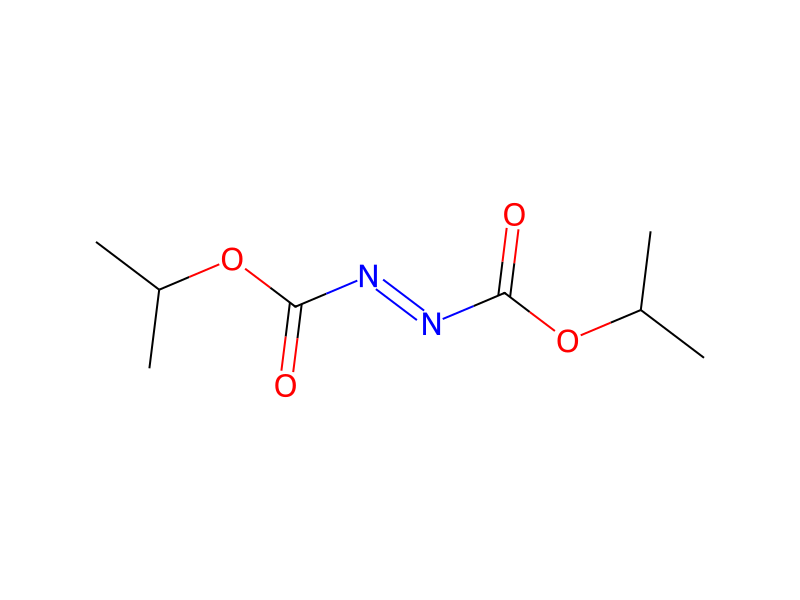

Product 1

Reagents, catalysts & solvents 2


Conditions
- Temperature
- 0 °C
Procedure
Add 88 mg (0.87 mmol) of 1-methyl-3-hydroxypyrrolidine, 246 mg (1.09 mmol) of triphenylphosphine and 0.01 mL (0.07 mmol) of TEA to a solution of 300 mg (0.72 mmol) of ethyl 6-(4-chloro-3-hydroxyphenyl)-5-(2,6-dimethoxyphenyl)pyridine-2-carboxylate in 2.5 mL of anhydrous THF cooled to 0° C. and placed under argon. After dissolution, add dropwise, at 0° C., a solution of 0.24 mL (1.09 mmol) of DIAD in 2.5 mL of anhydrous THF. Bring the reaction mixture to RT, stir for 18 h, then take up in 50 mL of EtOAc. Wash the organic phase successively with 20 mL of a saturated aqueous solution of sodium bicarbonate (NaHCO3) then 20 mL of water. After drying over Na2SO4 and concentration under reduced pressure, purify the residue obtained by silica gel column chromatography, eluting with a DCM/methanol gradient from 0 to 20% of methanol. After concentration under reduced pressure, we obtain 250 mg of ethyl 6-{4-chloro-3-[(1-methylpyrrolidin-3-yl)oxy]phenyl}-5-(2,6-dimethoxyphenyl)pyridine-2-carboxylate in the form of oil.
Workup
- dissolutionAfter dissolution
- additionadd dropwise, at 0° C.
- customto RT
- washWash the organic phase successively with 20 mL of a saturated aqueous solution of sodium bicarbonate (NaHCO3)
- dry with materialAfter drying over Na2SO4 and concentration under reduced pressure
- custompurify the residue
- customobtained by silica gel column chromatography
- washeluting with a DCM/methanol gradient from 0 to 20% of methanol
- concentrationAfter concentration under reduced pressure, we
Sources & evidence
- ORD record
- ord-d1c8f93c17564667b873c7e2c78d7e6f
- Source dataset
- uspto-grants-2013_10
- Patent number
- US08552201B2
Reaction notes
Loading…