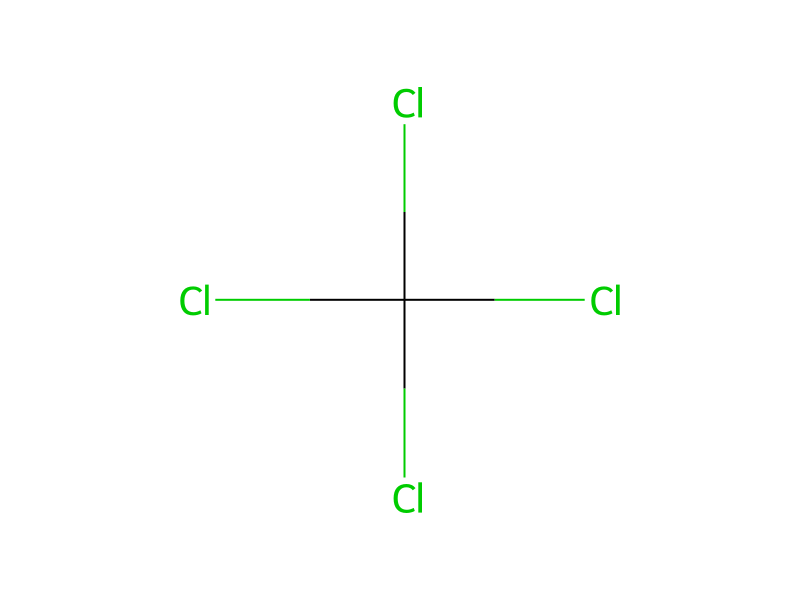
Carbon Tetrachloride → Neoheptanoyl chloride
Reaction equation

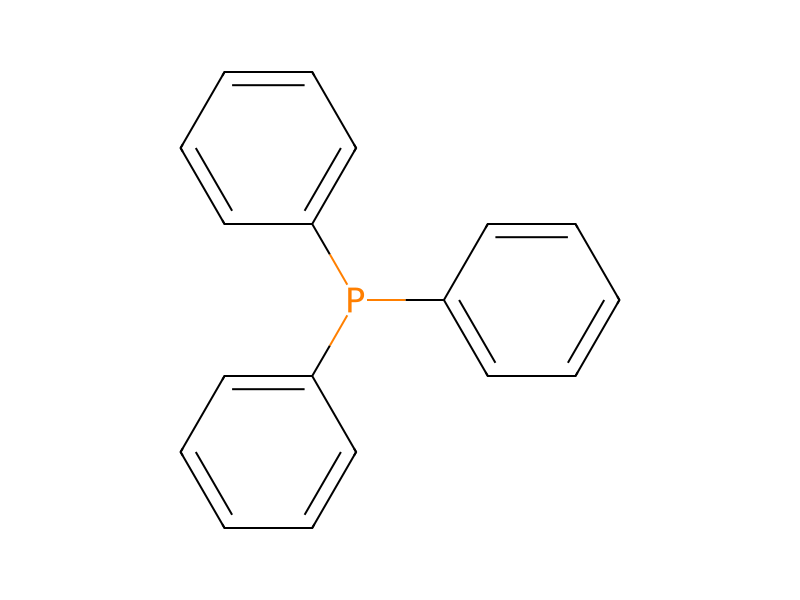
C1C=CC(P(C2C=CC=CC=2)C2C=CC=CC=2)=CC=1.[C:20]([OH:28])(=O)[CH2:21][CH2:22][C:23]([CH3:26])([CH3:25])[CH3:24].CC(C)(CCC)C(O)=O.C(C(C)(CC)C(O)=O)C.CC(C)(C(C)C)C(O)=O.P.C(Cl)(Cl)(Cl)[Cl:58]>O>[C:20]([Cl:58])(=[O:28])[CH2:21][CH2:22][C:23]([CH3:26])([CH3:25])[CH3:24]Participants
Reactant 7


Product 1

Reagents, catalysts & solvents 1
Conditions
- Temperature
- 80 °C
Procedure
A 604.45 g (2.3 mol, 1 eq.) portion of PPh3 was dissolved in 724 mL CCl4 in a 2 L three-necked round-bottom flask under N2 to give a hazy solution. A stirbar was added and the flask was fitted with a water-cooled condenser topped with a N2 inlet/outlet, mechanical stirrer and shaft, and an addition funnel. The addition funnel was charged with a solution of ExxonMobil Neoheptanoic Acid Prime (300 g, 2.30 mol uncorrected for purity) in 300 mL CCl4. This material was 94.1% purity with an isomer balance of 43.0% 2,2-dimethylpentanoic acid (DMPA), 37.6% 2-ethyl-2-methylbutanoic acid (EMBA), and 13.5% 2,2,3-trimethylbutanoic acid (TMBA) by GC analysis (using FID detection; uncorrected for response factor). The acid solution was added dropwise at room temperature while stirring over a 1 hour period. No immediate reaction was observed other than a decrease in haziness to give a clear solution. After stirring under N2 for an additional hour at room temperature, the addition funnel was removed and the contents of the flask were heated at reflux (˜80° C.) for 3 h. The formation of a white precipitate was observed upon heating. Subsequently, the mixture was cooled to room temperature and filtered. Solvent was removed from the filtrate using a rotary evaporator. The residue was cooled in a refrigerator for 24 h and subsequently crushed with a spatula and extracted with 800 mL hexane for 2 hours. Solids were removed by filtration and the hexane filtrate depleted of volatiles using a rotary evaporator and high vacuum (at 50° C.) to give 200 g of a crude material containing product, phosphine-containing residues, unreacted acid, and other species (most likely neoheptanoic anhydrides). Fractional distillation of the crude material gave neoheptanoic acid chloride as the first boiling fraction (50° C./2.4×10−2 torr; 57.4 g, 17%); higher boiling fractions contained species assigned as neoheptanoic anhydrides (13C NMR C═O 173.1-173.0 ppm; IR υC═O 1808 and 1741 cm−1) and free acids. Elemental analysis calc. for C17H13ClO: C, 56.57; H, 8.82; Cl, 23.85; O, 10.76. Found: C, 56.64; H, 8.96; Cl, 23.60. 1H NMR (CDCl3, 400 MHz): δ 2.17 (septet, J=6.9 Hz, CHMe2 of TMBA), 1.81 (app. sextet, J=7.3 Hz), 1.64-1.53 (m), and 1.35-1.29 (m) (probably CH2 groups of EMBA and DMPA), 1.28 (s, probably CMe2 of DMPA), 1.21 and 1.20 (2 singlets, probably CMeEt of EMBA and CMe2 of TMBA), 0.94-0.88 (m, CHMe2 of TMBA, CH2Me of EMBA, and CH2Me of DMPA). 13C NMR (CDCl3, 125 MHz): δ 180.53 (C═O of TMBA), 180.11 (C═O of DMPA), 179.75 (C═O of EMBA), 57.23 (CMeEt of EMBA), 56.17 (CMe2 of TMBA), 52.84 (CMe2 of DMPA), 42.55 (CH2 of DMPA), 34.34 (CHMe2 of TMBA), 31.41 (CH2 of EMBA), 25.11 (CMe2 of DMPA), 21.46 (CMe2 of TMBA), 20.38 (CMeEt of EMBA), 17.93 (CH2Me of DMPA), 17.22 (CHMe2 of TMBA), 14.32 (CH2Me of DMPA), 8.58 (CH2Me of EMBA). Isomer ratio (average of C═O and CR2 resonances): 12.6% TMBA, 42.1% EMBA, 45.4% DMPA. IR (NaCl disk): 2970 (s), 2940 (sh), 2877 (sh), 1789 (vs, υC═O), 1698 (m, may be acid υC═O from incidental hydrolysis), 1460 (m), 1387 (w), 1369 (sh), 1194 (w), 1066 (w), 1009 (w), 975 (w), 961 (w), 916 (vs), 888 (m), 864 (m), 804 (vs), 756 (w), 743 (w) cm1.
Workup
- customto give a hazy solution
- additionA stirbar was added
- temperaturecooled condenser
- customtopped with a N2 inlet/outlet, mechanical stirrer
- additionThe acid solution was added dropwise at room temperature
- customNo immediate reaction
- customto give a clear solution
- stirringAfter stirring under N2 for an additional hour at room temperature
- customthe addition funnel was removed
- temperaturethe contents of the flask were heated
- temperatureupon heating
- temperatureSubsequently, the mixture was cooled to room temperature
- filtrationfiltered
- customSolvent was removed from the filtrate
- customa rotary evaporator
- temperatureThe residue was cooled in a refrigerator for 24 h
- customsubsequently crushed with a spatula
- extractionextracted with 800 mL hexane for 2 hours
- customSolids were removed by filtration
- customa rotary evaporator and high vacuum (at 50° C.)
- customto give 200 g of a crude material
- distillationFractional distillation of the crude material
Sources & evidence
- ORD record
- ord-0ff1cd88f9744dd69972581a62d97458
- Source dataset
- uspto-grants-2013_10
- Patent number
- US08568846B2
Reaction notes
Loading…