Cesium carbonate → methyl 3-bromo-1H-indazole-6-carboxylate
Reaction equation

[CH3:1][O:2][C:3]([C:5]1[CH:13]=[C:12]2[C:8]([CH:9]=[N:10][NH:11]2)=[CH:7][CH:6]=1)=[O:4].C(=O)([O-])[O-].[Cs+].[Cs+].[Br:20]Br>C(#N)C>[Br:20][C:9]1[C:8]2[C:12](=[CH:13][C:5]([C:3]([O:2][CH3:1])=[O:4])=[CH:6][CH:7]=2)[NH:11][N:10]=1Participants
Reactant 3


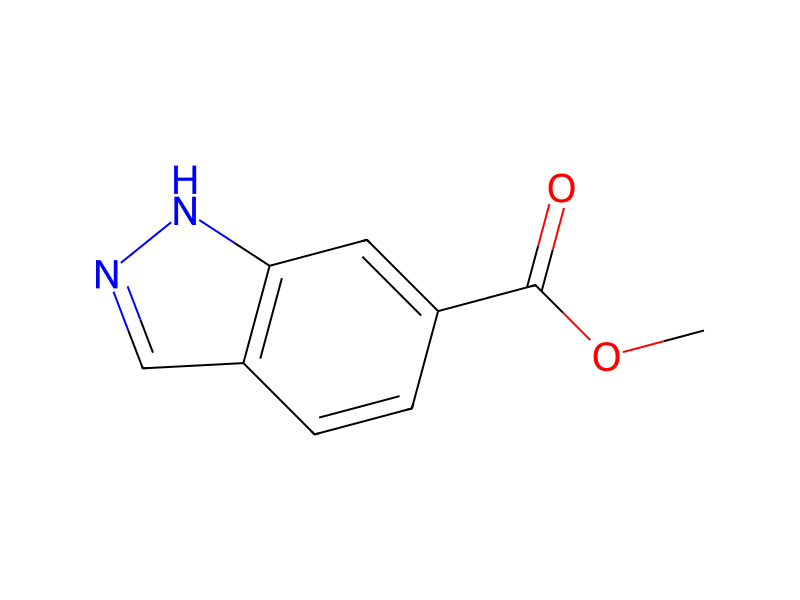
Product 1

Reagents, catalysts & solvents 1

Procedure
6-(1H)-indazole carboxylic acid methyl ester (1.5688 g, 8.90 mmol) and cesium carbonate (4.38 g, 13.44 mmol) were dissolved in acetonitrile (89 ml) at 25° C. Bromine (0.554 ml, 10.75 mmol) was added and the reaction mixture was allowed to stir for 20 min. The reaction was stopped, quenched by addition of saturated aqueous sodium hydrogen carbonate (30 mL) and 10% aqueous sodium thiosulfate (30 mL), and the mixture extracted with ethyl acetate (3×50 mL). The combined organic phases were washed with saturated aqueous sodium chloride (1×50 mL), dried (sodium sulfate), filtered, and the solvent evaporated under reduced pressure. The title compound (2.241 g, 8.79 mmol, 99% yield) was recovered as a light orange/white solid. LC-MS: [M+1]=255.2.
Workup
- customquenched by addition of saturated aqueous sodium hydrogen carbonate (30 mL) and 10% aqueous sodium thiosulfate (30 mL)
- extractionthe mixture extracted with ethyl acetate (3×50 mL)
- washThe combined organic phases were washed with saturated aqueous sodium chloride (1×50 mL)
- dry with materialdried (sodium sulfate)
- filtrationfiltered
- customthe solvent evaporated under reduced pressure
Sources & evidence
- ORD record
- ord-9a524232e8d14a97b1e78e5c663309b2
- Source dataset
- uspto-grants-2013_10
- Patent number
- US08569512B2
Reaction notes
Loading…