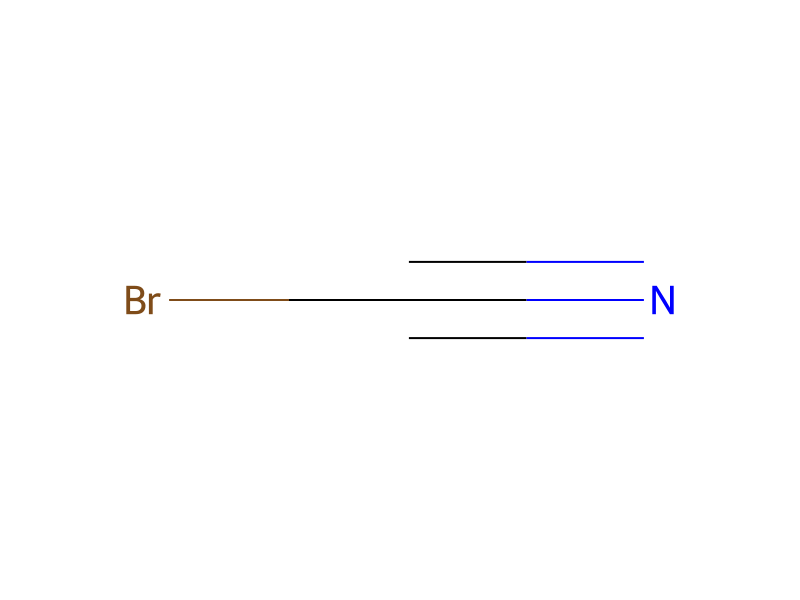
Cyanogen Bromide → HCID 178472589, compound
Reaction equation

[CH:1]1[C:6]2[N:7]=[C:8]3[N:13]([CH2:14][C:5]=2[C:4]([Cl:15])=[C:3]([Cl:16])[CH:2]=1)[CH2:12][C:10](=[O:11])[NH:9]3.NC1C(CN[CH2:26][C:27](OCC)=[O:28])=C(Cl)C(Cl)=CC=1.N#CBr>C1(C)C=CC=CC=1>[Cl:15][C:4]1[C:3]([Cl:16])=[CH:2][CH:1]=[C:6]2[C:5]=1[CH2:14][N:13]([CH2:12][C:10]([O:28][CH2:27][CH3:26])=[O:11])[C:8](=[NH:9])[NH:7]2Participants
Reactant 3


Product 1

Reagents, catalysts & solvents 1

Procedure
Anagrelide is an imidazoquinazoline that is sparingly soluble in dimethylsulfoxide and N,N-dimethylformamide and very slightly soluble in water. Anagrelide is insoluble in diethyl ether or n-heptane. Anagrelide can be made using any of the processes known in the art (e.g., see U.S. Pat. Nos. 3,932,407; 4,146,718; 4,208,521; 4,357,330; Re 31,617; 5,801,245, and 6,388,073 and WO/2002/008228). Commercially, as discussed in U.S. Pat. No. 5,801,245, anagrelide has been prepared as the hydrochloride monohydrate from the intermediate, ethyl N-(6-amino-2,3-dichlorobenzyl)glycine by reaction with cyanogen bromide in hot alcohol solution, or, preferentially, by reaction with cyanogen bromide (CNBr) in an aprotic solvent to give the iminoquinazoline intermediate, which is isolated and then reacted with a base in a hot solution of alcohol to form anagrelide base. For example, anagrelide can be prepared as shown in Scheme I below, by treating ethyl 2-(6-amino-2,3-dichlorobenzyl-amino)acetate with CNBr in toluene under reflux to produce ethyl 2-(5,6-dichloro-2-imino-1,2-dihydroquinazolin-3(4H)-yl)acetate, which, when treated with triethylamine in ethanol under reflux, yields anagrelide free base. The free base can be converted to anagrelide hydrochloride monohydrate by appropriate treatment with HCl. The CAS® Registry Number for anagrelide monohydrochloride is 58579-51-4.
Workup
- temperatureunder reflux
Sources & evidence
- ORD record
- ord-05349e71612447e2a18c93354e202697
- Source dataset
- uspto-grants-2016_07
- Patent number
- US09381198B2
Reaction notes
Loading…