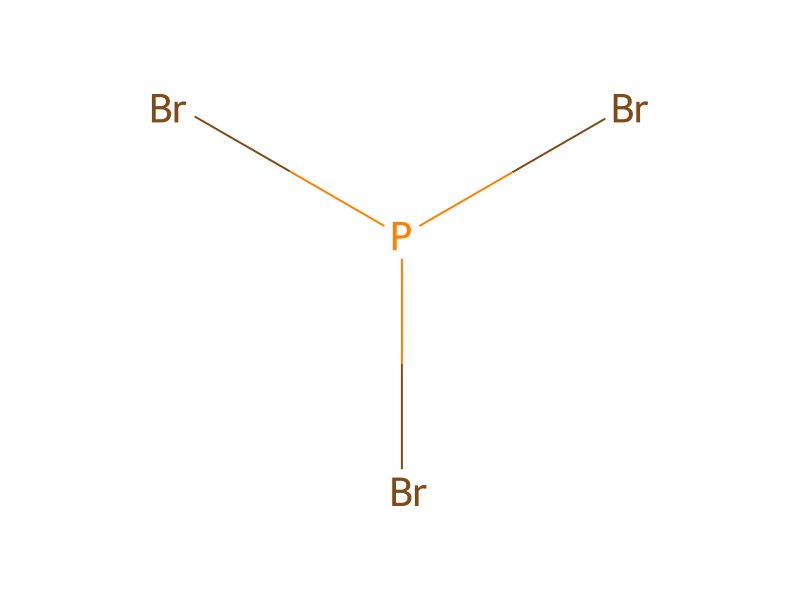
Phosphorus tribromide → HCID 59635624, compound
Reaction equation

O[CH2:2][C:3]1[CH:8]=[CH:7][C:6]([C:9]2[N:14]3[N:15]=[C:16]([NH:18][C:19]([CH:21]4[CH2:23][CH2:22]4)=[O:20])[N:17]=[C:13]3[CH:12]=[CH:11][CH:10]=2)=[CH:5][CH:4]=1.P(Br)(Br)[Br:25]>C(Cl)(Cl)Cl>[Br:25][CH2:2][C:3]1[CH:8]=[CH:7][C:6]([C:9]2[N:14]3[N:15]=[C:16]([NH:18][C:19]([CH:21]4[CH2:23][CH2:22]4)=[O:20])[N:17]=[C:13]3[CH:12]=[CH:11][CH:10]=2)=[CH:5][CH:4]=1Participants
4
Reactant 2

Product 1

Reagents, catalysts & solvents 1

Procedure
To a solution of cyclopropanecarboxylic acid [5-(4-hydroxymethyl-phenyl)-[1,2,4]triazolo[1,5-a]pyridin-2-yl]-amide (1.0 eq) in chloroform is slowly added phosphorus tribromide (1.0 eq.). The reaction mixture is stirred at room temperature for 20 h, quenched with ice and water (20 mL) and extracted with dichloromethane. The organic layer is dried over anhydrous MgSO4, filtered and concentrated to dryness. The resulting white residue is triturated in dichloromethane/diethyl ether 2:1 to afford the desired product.
Workup
- customquenched with ice and water (20 mL)
- extractionextracted with dichloromethane
- dry with materialThe organic layer is dried over anhydrous MgSO4
- filtrationfiltered
- concentrationconcentrated to dryness
- customThe resulting white residue is triturated in dichloromethane/diethyl ether 2:1
Sources & evidence
- ORD record
- ord-c0b947236f6e46b8844c1d325369719a
- Source dataset
- uspto-grants-2016_07
- Patent number
- US09382247B2
Reaction notes
Loading…