Pyridine → N-(4-Bromophenyl)-2-chloroacetamide
Reaction equation

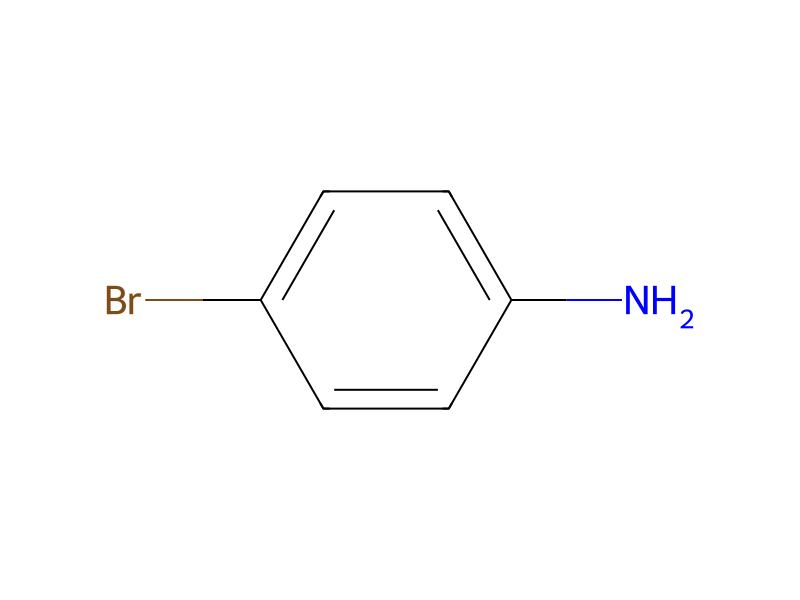
[Br:1][C:2]1[CH:8]=[CH:7][C:5]([NH2:6])=[CH:4][CH:3]=1.N1C=CC=CC=1.[Cl:15][CH2:16][C:17](Cl)=[O:18]>ClCCl>[Br:1][C:2]1[CH:8]=[CH:7][C:5]([NH:6][C:17](=[O:18])[CH2:16][Cl:15])=[CH:4][CH:3]=1Participants
5
Reactant 3


Product 1

Reagents, catalysts & solvents 1

Procedure
4-bromoaniline (1.72 g, 10 mmol) was dissolved in 50 mL dichloromethane. Pyridine (cat.) was added and then 2-chloroacetyl chloride (800 uL, 10 mmol) was added dropwise. The reaction was stirred at room temperature for 1 hr. The reaction was quenched with water and the aqueous layer was extracted with dichloromethane (2×25 mL). The combined organic layer was washed with water, then brine, and dried over Na2SO4. The solvent was evaporated to give the intermediate 7a (1.03 g, 4 mmol, 42% yield). 1H NMR (400 MHz, Chloroform-d) δ 8.24 (broad s, 1H), 7.54-7.44 (m, 4H), 4.21 (s, 2H).
Workup
- customThe reaction was quenched with water
- extractionthe aqueous layer was extracted with dichloromethane (2×25 mL)
- washThe combined organic layer was washed with water
- dry with materialbrine, and dried over Na2SO4
- customThe solvent was evaporated
Sources & evidence
- ORD record
- ord-ed3167e9007a41a69c2b150e76663f30
- Source dataset
- uspto-grants-2016_07
- Patent number
- US09394233B2
Reaction notes
Loading…