HuagongsheHuagongshe Chemistry Print Report · For research reference only
Catechol → 2-(2,3-Dihydro-1,4-benzodioxin-2-yl)acetonitrile
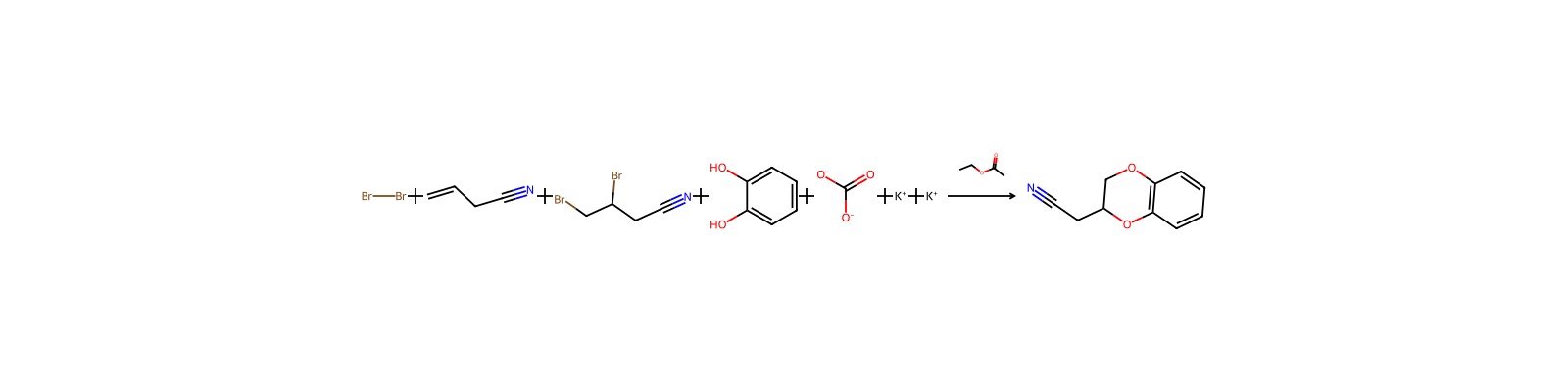
Participants
| Role | Name | HCID | Charge |
|---|---|---|---|
| Reactant | Catechol | HCID 289 | — |
| Reactant | 3-Butenenitrile | HCID 8009 | — |
| Reactant | Potassium Carbonate | HCID 11430 | — |
| Reactant | Bromine | HCID 24408 | — |
| Reactant | 3,4-Dibromobutanenitrile | HCID 11831139 | — |
| Solvent | Ethyl Acetate | HCID 8857 | — |
| Product | 2-(2,3-Dihydro-1,4-benzodioxin-2-yl)acetonitrile | HCID 267531 | — |
Reaction Steps
The starting material is prepared as follows: To the solution of 1,134 g of bromine in 1,400 ml of ethyl acetate 472 g of allyl cyanide are added dropwise while stirring for 90 minutes at -10°-0°. The resulting solution of 3,4-dibromobutyronitrile is added all at once to the solution prepared from 705 g of catechol and 1,987 g of anhydrous potassium carbonate in 5,000 ml of refluxing ethyl acetate, while stirring at 35° under nitrogen. The mixture is refluxed for 4 hours and stirred overnight at room temperature. It is filtered, the residue washed with 2,000 ml of ethyl acetate, the filtrate evaporated, the residue distilled and the fraction boiling at 138°/1.4-131°/1.1 mm Hg collected, to yield the 1,4-benzodioxan-2-yl-acetonitrile.
Provenance & Evidence
| DOI | 10.6084/m9.figshare.5104873.v1 |
|---|---|
| Patent number | US04329348 |
| Source dataset | uspto-grants-1982_05 |
| ORD ID | ord-bb7d498d071d4c2e8452b1b68b2eb9a4 |
| Source note | uspto-grants-1982_05 |