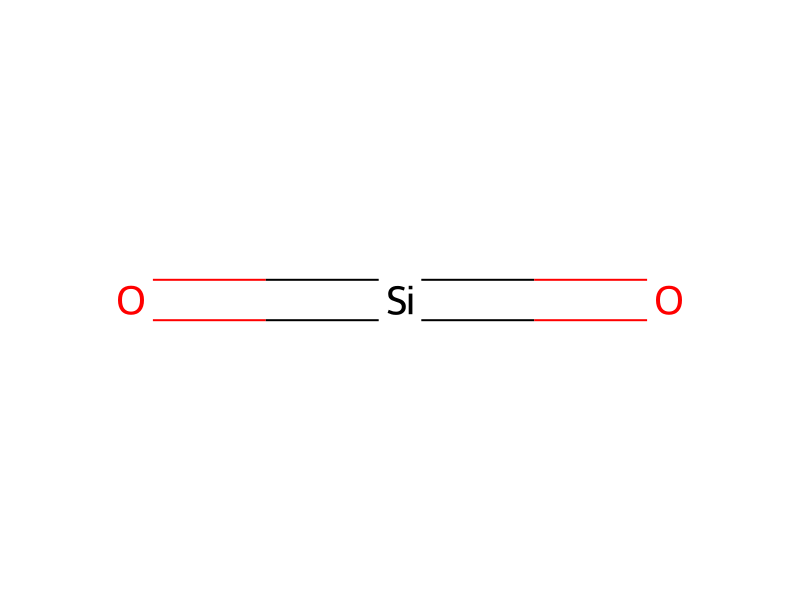
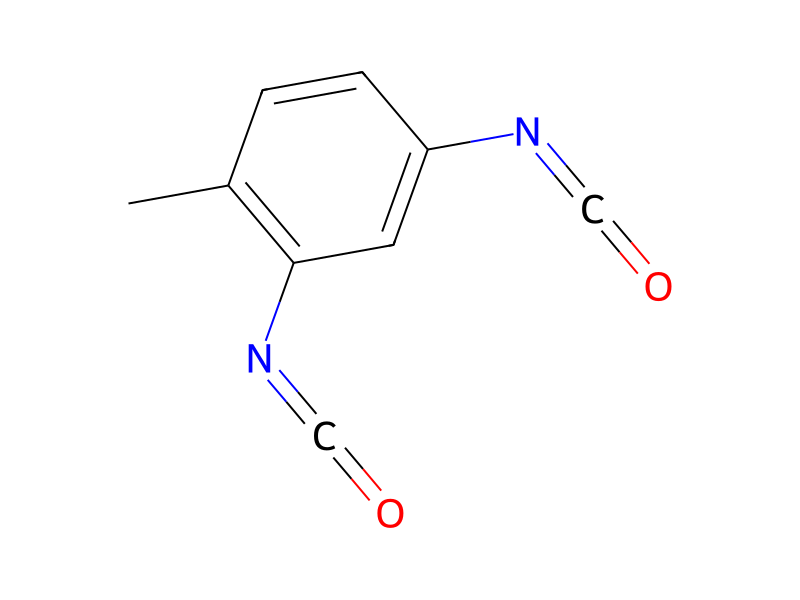
Silica → Toluene 2,4-Diisocyanate
Reaction equation

C([O:5][C:6]([NH:8][C:9]1[CH:14]=[C:13]([NH:15][C:16](OCCCC)=[O:17])[CH:12]=[CH:11][C:10]=1[CH3:23])=O)CCC.O=[Si]=O.[Al]>C(C1C=CC=CC=1)CCCCCCCCCCC>[CH3:23][C:10]1[CH:11]=[CH:12][C:13]([N:15]=[C:16]=[O:17])=[CH:14][C:9]=1[N:8]=[C:6]=[O:5]Participants
Reactant 3


Product 1
Reagents, catalysts & solvents 1

Conditions
- Temperature
- 320 °C
Procedure
170 Parts of 2,4-di-(butoxycarbonylamino)-toluene were dissolved in 350 parts of dodecylbenzene. With a feed rate of 300 liters per liter of reaction volume an hour, this solution was fed into a separating reactor of quartz glass filled with an aluminum graulate having a grain size of 1 millimeter to 3 millimeters and heated to a temperature of 320° C. Using 8 liters of nitrogen per liter of reaction mixture an hour as a stripping agent, the butanol resulting from the reaction was separated in a gaseous form and condensed in a vessel cooled with dry ice. This resulted in 443 parts of reaction discharge from which 81 parts of 2,4-toluene diisocyanate (88.2 theoretical percent relative to reacted 2,4-di-(butoxycarbonylamino)-toluene) were obtained by distillation at a temperature between 76° C. and 82° C. and a pressure of 0.2 millibar. The raw material had reacted completely. A mixture of refluxable 2-butoxycarbonylamino-4-isocyanatotoluene and 4-(butoxycarbonylamino)-2-isocyanototoluene was proven in the distillation residue by means of gas chromatography.
Workup
- customWith a feed rate of 300 liters per liter of reaction volume an hour
- customper liter of reaction mixture an hour as a stripping agent
- customthe butanol resulting from the reaction was separated in a gaseous form and condensed in a vessel
- temperaturecooled with dry ice
Sources & evidence
- ORD record
- ord-c72b82267a8d4fdaaae0237ec4a14d24
- Source dataset
- uspto-grants-1982_05
- Patent number
- US04330479
Reaction notes
Loading…