Formaldehyde → 2-(Morpholinomethyl)acrylic acid
Reaction equation
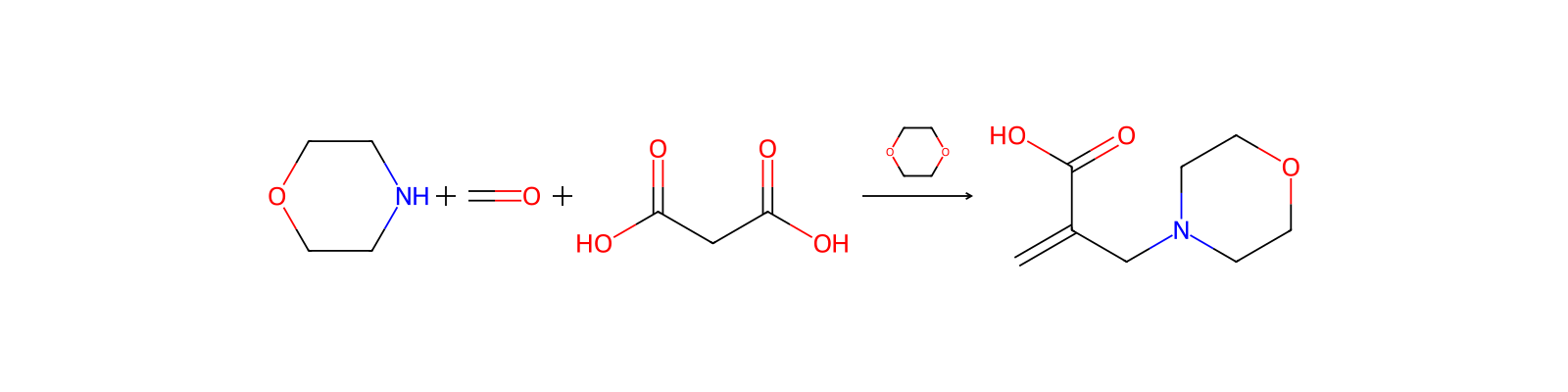
[NH:1]1[CH2:6][CH2:5][O:4][CH2:3][CH2:2]1.[CH2:7]=O.[C:9](O)(=O)[CH2:10][C:11]([OH:13])=[O:12]>O1CCOCC1>[N:1]1([CH2:7][C:10](=[CH2:9])[C:11]([OH:13])=[O:12])[CH2:6][CH2:5][O:4][CH2:3][CH2:2]1Participants
5
Reactant 3



Product 1

Reagents, catalysts & solvents 1

Procedure
In a manner described by Krawczyk [Henryk Krawczyk, Synthetic Communications, 25 641-650, (1995)] an 8.8 mL (8.8 g; 0.1 mole) portion of morpholine was added to 6.6 g (0.22 eq) of paraformaldehyde and 10.4 g (0.1 mole) of malonic acid in 100 mL of dioxane. After heating in an oil bath at 70 deg for 1 {fraction (1/12)} hours, the solvents were removed in vacuo. The residue was dissolved in acetone, some insoluble material being filtered. The filtrate was taken to an oil in vacuo. This oil was chromatographed on silica gel. Elution of the product with 1:19 methanol methylene chloride gave 5.51 g (32%) of the product, which melted at 121-125° C.
Workup
- customthe solvents were removed in vacuo
- dissolutionThe residue was dissolved in acetone
- filtrationsome insoluble material being filtered
- customThis oil was chromatographed on silica gel
- washElution of the product with 1:19 methanol methylene chloride
Sources & evidence
- ORD record
- ord-5701ceeb14254d90ab4ec3bcff23941f
- Source dataset
- uspto-grants-2001_06
- Patent number
- US06251912B1
Reaction notes
Loading…