Acetyl chloride → Methyl 4-Bromo-2-chlorobenzoate
Reaction equation
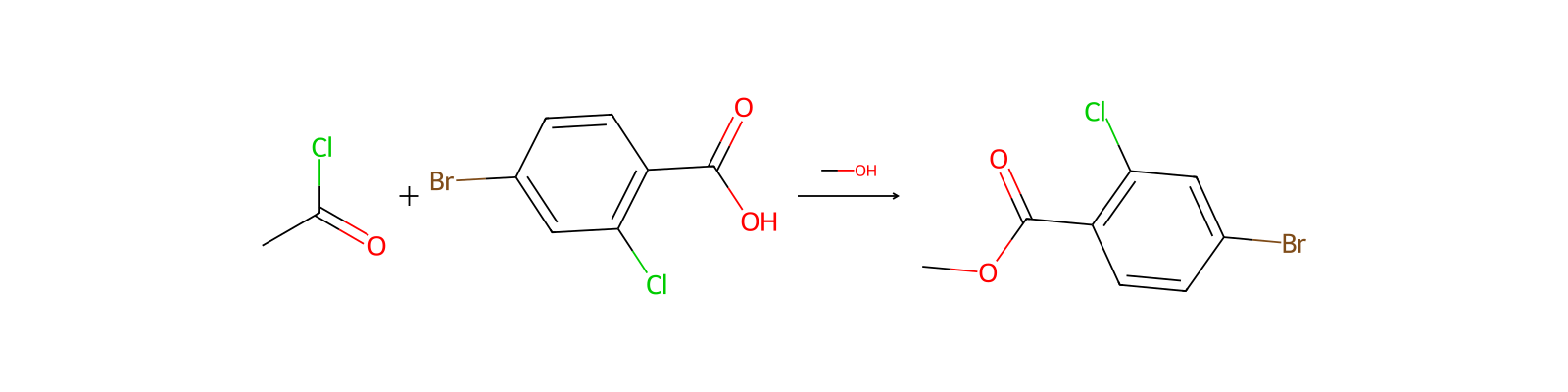
[C:1](Cl)(=O)C.[Br:5][C:6]1[CH:14]=[CH:13][C:9]([C:10]([OH:12])=[O:11])=[C:8]([Cl:15])[CH:7]=1>CO>[Br:5][C:6]1[CH:14]=[CH:13][C:9]([C:10]([O:12][CH3:1])=[O:11])=[C:8]([Cl:15])[CH:7]=1Participants
4
Reactant 2


Product 1

Reagents, catalysts & solvents 1

Procedure
To anhydrous methanol (45 mL) was added acetyl chloride (1.9 mL) over 2 min. The mixture, which became slightly exothermic and evolved gas, was stirred for 15 min. 4-Bromo-2-chlorobenzoic acid (3.0 g) was added in one portion and the mixture was heated at gentle reflux for 16 h. The mixture was allowed to cool to room temperature and the solvent was removed with a rotary evaporator. The residue was partitioned between saturated aqueous sodium bicarbonate and diethyl ether. The organic layer was separated, dried over sodium sulfate, filtered and concentrated to afford the title compound as a white solid (2.89 g).
Workup
- temperaturethe mixture was heated
- temperatureat gentle reflux for 16 h
- customthe solvent was removed with a rotary evaporator
- customThe residue was partitioned between saturated aqueous sodium bicarbonate and diethyl ether
- customThe organic layer was separated
- dry with materialdried over sodium sulfate
- filtrationfiltered
- concentrationconcentrated
Sources & evidence
- ORD record
- ord-4e9d030bdd1241fdaf0f00d0324d1e34
- Source dataset
- uspto-grants-2001_06
- Patent number
- US06251925B1
Reaction notes
Loading…