Hydrazine → 1-(3-aminobutyl)-4-chloro-5-methyl-1H-pyrrole-2-carbonitrile
Reaction equation
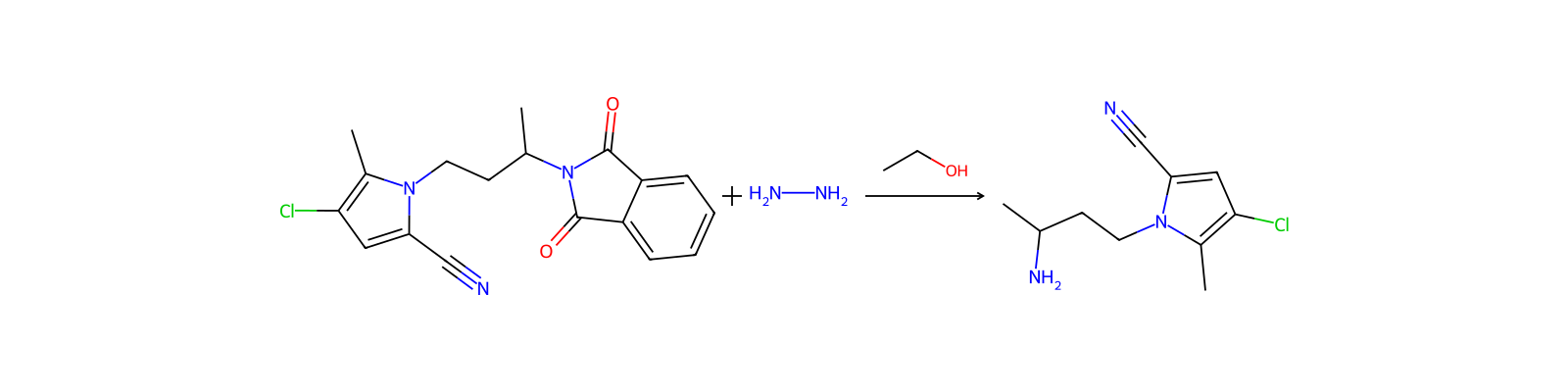
[Cl:1][C:2]1[CH:3]=[C:4]([C:23]#[N:24])[N:5]([CH2:8][CH2:9][CH:10]([N:12]2C(=O)C3C(=CC=CC=3)C2=O)[CH3:11])[C:6]=1[CH3:7].NN>C(O)C>[NH2:12][CH:10]([CH3:11])[CH2:9][CH2:8][N:5]1[C:6]([CH3:7])=[C:2]([Cl:1])[CH:3]=[C:4]1[C:23]#[N:24]Participants
4
Reactant 2


Product 1

Reagents, catalysts & solvents 1

Procedure
A solution of 3.2 g (9.4 mmol) of 4-chloro-1-[3-(1,3-dihydro-1,3-dioxo-2H-isoindol-2-yl)butyl]-5-methyl-1H-pyrrole-2-carbonitrile and 4.8 mL (94 mmol) of hydrazine in ethanol was heated at reflux for 60 min and cooled to room temperature. Precipitated solids were filtered and rinsed with ethyl acetate and the filtrate was concentrated to afford 1-(3-aminobutyl)-4-chloro-5-methyl-1H-pyrrole-2-carbonitrile as an oil. Step D: Preparation of 2-cyano-3,4,4-trimethylpentanoic acid
Workup
- temperatureat reflux for 60 min
- customPrecipitated solids
- filtrationwere filtered
- washrinsed with ethyl acetate
- concentrationthe filtrate was concentrated
Sources & evidence
- ORD record
- ord-00dfc117e26848d8b4ccfc89ef271880
- Source dataset
- uspto-grants-2001_06
- Patent number
- US06251947B1
Reaction notes
Loading…