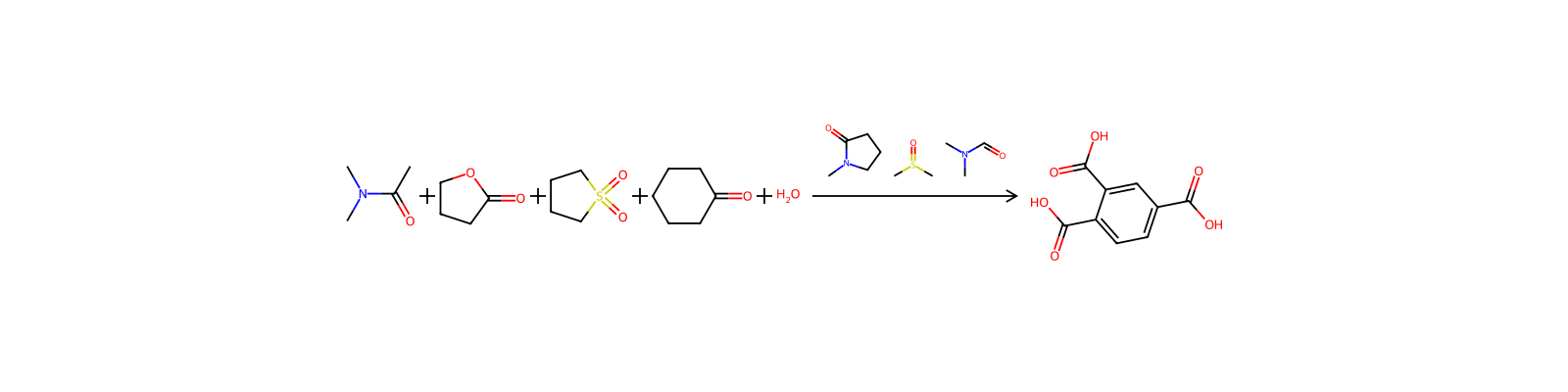
Participants
| Role | Name | HCID | Charge |
|---|
| Reactant | Water | HCID 962 | — |
| Reactant | Gamma-Butyrolactone | HCID 7302 | — |
| Reactant | Cyclohexanone | HCID 7967 | — |
| Reactant | Sulfolane | HCID 31347 | — |
| Reactant | Dimethylacetamide | HCID 31374 | — |
| Solvent | Dimethyl Sulfoxide | HCID 679 | — |
| Solvent | Dimethylformamide | HCID 6228 | — |
| Solvent | N-methyl-2-pyrrolidone | HCID 13387 | — |
| Product | Trimellitic acid | HCID 10708 | — |
Reaction Steps
Examples of the aprotic polar solvents useful in the present invention include dimethylacetamide, dimethylformamide, dimethyl sulfoxide, N-methyl-2-pyrrolidone, 4-butyrolactone, sulfolane and cyclohexanone. Those boiling at 150 to 210° C., particularly N-methyl-2-pyrrolidone (abbreviated, hereinafter, to “NMP”), are desirable since imide preparations require high temperatures. The water content in the aprotic polar solvent is preferably kept to 0.2% by weight or less because hydration of TMA produces trimellitic acid, which interferes with the reaction and lowers the molecular weight of polymers. The amount of the aprotic polar solvent is preferably such that the diamine (A), the siloxanediamine (B) and trimellitic anhydride (C) make a total of 10 to 70% by weight, more preferably 15 to 35% by weight, based on the total of them with the aprotic polar solvent. A total of diamine (A), the siloxanediamine (B) and trimellitic anhydride (C) of less than 10% by weight is advantageous to industrial production. If (A), (B) and (C) make a total above 70% by weight, the solubilities of TMA (C) and the diimidodicarboxylic acid mixture (Y) will become insufficient to carry out satisfactory reaction.
Provenance & Evidence
| DOI | 10.6084/m9.figshare.5104873.v1 |
|---|
| Patent number | US06252010B1 |
|---|
| Source dataset | uspto-grants-2001_06 |
|---|
| ORD ID | ord-f0ca4a1888f7400a9ba0efdc2bc00257 |
|---|
| Source note | uspto-grants-2001_06 |
|---|