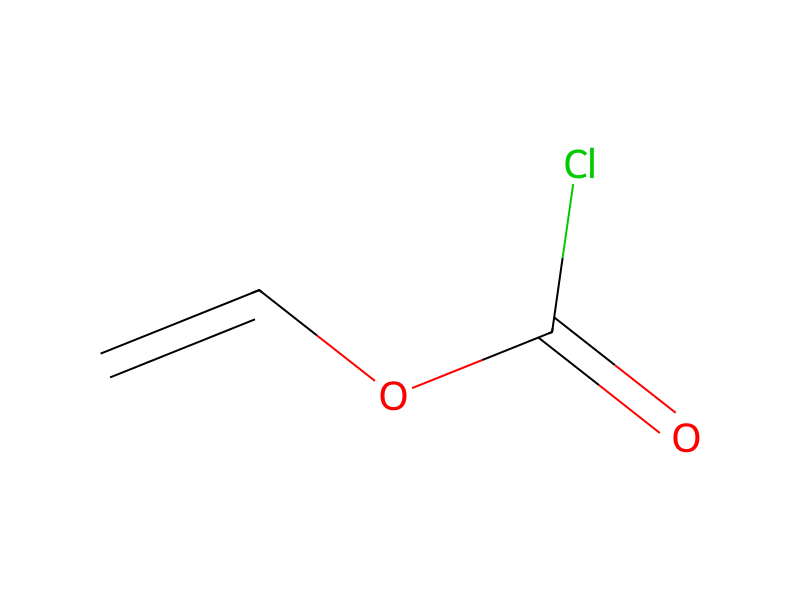
Vinyl chloroformate → HCID 15928270, compound
Reaction equation

[C:1]([CH2:3][C@H:4]1[CH2:9][CH2:8][N:7](CC=C)[C@@H:6]([C:13]([O:15][CH2:16][CH3:17])=[O:14])[CH2:5]1)#[N:2].Cl[C:19]([O:21][CH:22]=[CH2:23])=[O:20].CN(C)C1C2C(=CC=CC=2N(C)C)C=CC=1>ClCCl>[C:1]([CH2:3][C@H:4]1[CH2:9][CH2:8][N:7]([C:19]([O:21][CH:22]=[CH2:23])=[O:20])[C@@H:6]([C:13]([O:15][CH2:16][CH3:17])=[O:14])[CH2:5]1)#[N:2]Participants
5
Reactant 3


Product 1

Reagents, catalysts & solvents 1

Procedure
A solution of 2.0 g of the product from step C above, 1.8 g (16.5 mmol) of vinyl chloroformate and 3.5 g (16.5 mmol) of 1,8-bis-dimethylaminonaphthalene in 40 ml of dichloromethane was heated to reflux for 6 hr. The mixture was then cooled to ambient temperature and concentrated under vacuum. The residue was dissolved in diethyl ether and was washed twice with 10% aqueous sodium hydrogen sulfate and once with saturated aqueous sodium bicarbonate. The organic layer was dried over magnesium sulfate, filtered and concentrated under vacuum. Preparative HPLC afforded 1.8 g (79%) of the desired intermediate, [α]D =-24.8° (c=1, dichloromethane).
Workup
- temperatureto reflux for 6 hr
- concentrationconcentrated under vacuum
- dissolutionThe residue was dissolved in diethyl ether
- washwas washed twice with 10% aqueous sodium hydrogen sulfate and once with saturated aqueous sodium bicarbonate
- dry with materialThe organic layer was dried over magnesium sulfate
- filtrationfiltered
- concentrationconcentrated under vacuum
Sources & evidence
- ORD record
- ord-16bab3178c4b4a79bf1e83aabf79ac1c
- Source dataset
- uspto-grants-1990_11
- Patent number
- US04968678
Reaction notes
Loading…