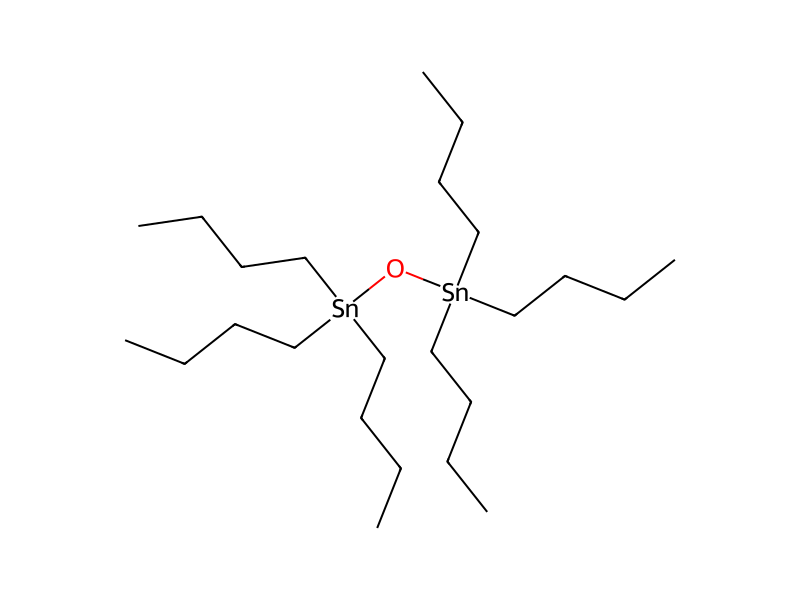
Sodium Hydroxide → Bis(tributyltin) oxide
Reaction equation

[OH-:1].[Na+].[CH2:3]([Sn:7](Cl)([CH2:12][CH2:13][CH2:14][CH3:15])[CH2:8][CH2:9][CH2:10][CH3:11])[CH2:4][CH2:5][CH3:6]>>[CH3:6][CH2:5][CH2:4][CH2:3][Sn:7]([O:1][Sn:7]([CH2:8][CH2:9][CH2:10][CH3:11])([CH2:12][CH2:13][CH2:14][CH3:15])[CH2:3][CH2:4][CH2:5][CH3:6])([CH2:12][CH2:13][CH2:14][CH3:15])[CH2:8][CH2:9][CH2:10][CH3:11]Participants


Conditions
- Temperature
- 50 °C
Procedure
A four-necked flask was provided with a stirrer, a thermometer and a reflux condenser. Then, 385 g of 20% aqueous sodium hydroxide solution was introduced into the flask and heated to 50° C. 200 g of tri-n-butyltin chloride containing 4.8% di-n-butyltin dichloride was dropwise added thereto over a period of 30 minutes, and then, reaction was allowed to proceed at that temperature for an hour. The resulting reaction mixture was permitted to stand, whereby it split into a turbid organic phase and an aqueous phase, respectively having specific gravities of 1.15 and 1.2. However, the diameters of the thus-formed di-n-butyltin oxide particles were so small as to cause the interface to be in an indistinct emulsified state and, hence, separation of the two phases was difficult. The organic phase was a mixture of bis(tri-n-butyltin) oxide and di-n-butyltin oxide particles having an average particle diameter of 2 μm. Vacuum filtration was tried on this organic phase but the two oxides could not be separated. Hence, 5 g of acid clay was added to the organic phase as a filter aid, which was then filtered. 100 g of water was added to the resulting filtate for washing, and the resulting organic phase was taken out and then dehydrated under reduced pressure, thereby obtaining 167 g of bis(tri-n-butyltin) oxide. Hydrochloric acid titration revealed that its purity was 96.3%, and its yield based on the starting material was 92%.
Workup
- customA four-necked flask was provided with a stirrer
- customreaction
- waitto proceed at that temperature for an hour
- customThe resulting reaction mixture
- customwhereby it split into a turbid organic phase
- customhence, separation of the two phases
- additiona mixture of bis(tri-n-butyltin) oxide and di-n-butyltin oxide particles
- filtrationVacuum filtration
- customthe two oxides could not be separated
- additionHence, 5 g of acid clay was added to the organic phase as a filter aid, which
- filtrationwas then filtered
- addition100 g of water was added to the resulting filtate
- washfor washing
Sources & evidence
- ORD record
- ord-1796687cf8dc4b04bf6d6cd1d3e9e346
- Source dataset
- uspto-grants-1990_11
- Patent number
- US04968823
Reaction notes
Loading…