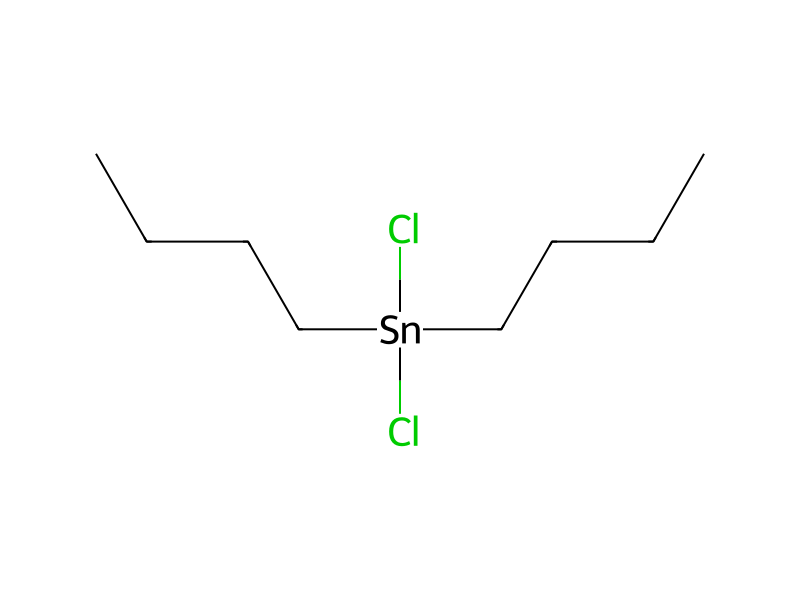
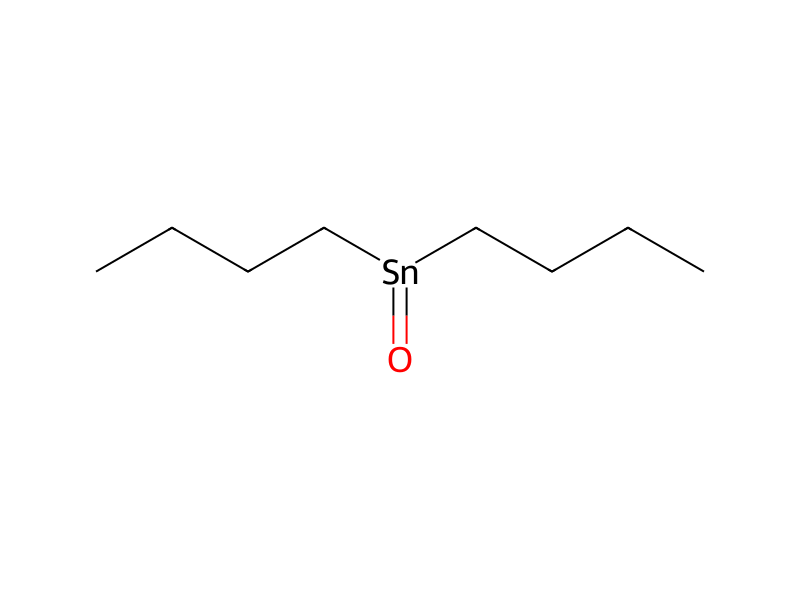
Dibutyltin dichloride → Dibutyltin oxide
Reaction equation

[OH-:1].[Na+].[CH2:3]([Sn:7](Cl)(Cl)[CH2:8][CH2:9][CH2:10][CH3:11])[CH2:4][CH2:5][CH3:6].[Cl].[Cl].[Cl].C([Sn])CCC>C1(C)C=CC=CC=1>[CH2:3]([Sn:7](=[O:1])[CH2:8][CH2:9][CH2:10][CH3:11])[CH2:4][CH2:5][CH3:6]Participants
Reactant 3


Product 1
Reagents, catalysts & solvents 1

Conditions
- Temperature
- 75 °C
Procedure
The same apparatus as used in Example 1 was employed. To the flask were continuously fed 1,300 g of 16% aqueous sodium hydroxide solution and 5,504 g of a toluene solution which had been prepared by dissolving, in 3,592 g of toluene, 1,912 g of di-n-butyltin dichloride containing 1.5% tri-n-butyltin chloride and 1.0% mono-n-butyltin trichlorine. The above feeding was performed with stirring and heating at 75° C., to conduct hydrolysis for 60 minutes. The resulting reaction mixture overflowed was allowed to stand, thereby splitting into three distinct phases. The specific gravities of the upper, intermediate and lower phases were 00.6, 1.1 and 1.2, respectively. These three phases were separated from one another and then subjected to the same treatments as in Example 4. As a result, the lower phase gave 1,520 g of di-n-butyltin oxide having a purity of 99.8% and an average particle diameter of 80 μm; the intermediate phase gave 2.6 g of mono-n-butyltin oxide having a purity of 95.9%; and the upper phase gave 5.9 g of bis(tri-n-butyltin) oxide having a purity of 95.6%. The total yield based on the starting material was 99.2%.
Workup
- customhad been prepared
- customhydrolysis for 60 minutes
- customThe resulting reaction mixture
- customThese three phases were separated from one another and
Sources & evidence
- ORD record
- ord-c45aa1c9543245ee992460d13404c6ad
- Source dataset
- uspto-grants-1990_11
- Patent number
- US04968823
Reaction notes
Loading…