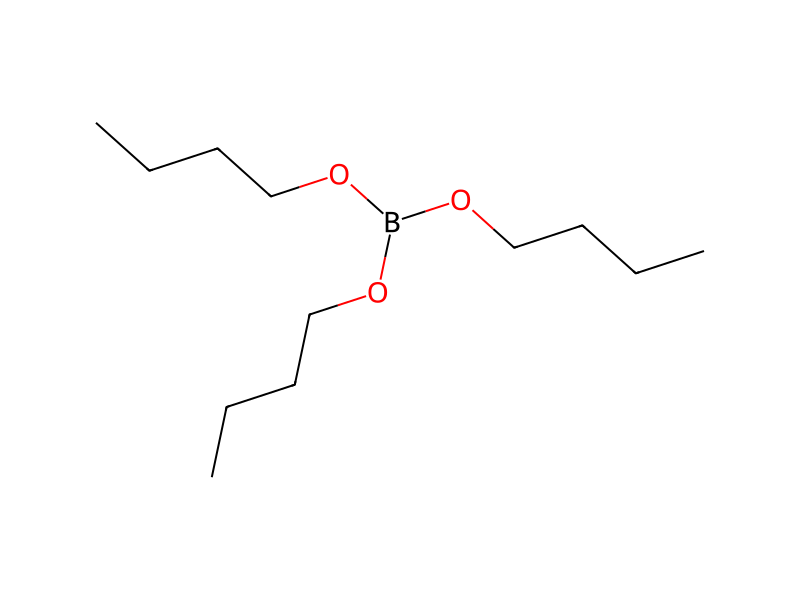
Tributyl borate → HCID 20495657, compound
Reaction equation

[B:1](OCCCC)(OCCCC)[O:2][CH2:3][CH2:4][CH2:5][CH3:6].[C:17]([C:21]1[CH:26]=[C:25]([CH3:27])[CH:24]=[C:23]([C:28]([CH3:31])([CH3:30])[CH3:29])[C:22]=1[OH:32])([CH3:20])([CH3:19])[CH3:18].[CH3:33][CH:34]1[CH:39]([CH3:40])[CH2:38][CH2:37][CH:36]([OH:41])[CH2:35]1>C(O)CCC>[B:1]([O:32][C:22]1[C:21]([C:17]([CH3:20])([CH3:19])[CH3:18])=[CH:26][C:25]([CH3:27])=[CH:24][C:23]=1[C:28]([CH3:31])([CH3:30])[CH3:29])([O:41][CH:36]1[CH2:37][CH2:38][CH:39]([CH3:40])[CH:34]([CH3:33])[CH2:35]1)[O:2][CH2:3][CH2:4][CH2:5][CH3:6]Participants
Reactant 3


Product 1

Reagents, catalysts & solvents 1

Conditions
- Temperature
- 280 °C
Procedure
n-butyl 3,4-dimethylcyclohexyl 2,6-di-t-butyl-4-methylphenyl borate was prepared by successively transesterifying tri-n-butyl borate with 2,6-di-t-butyl-4-methylphenol and 3,4-dimethylcyclohexanol. Tri-n-butyl borate (1 mole) and 2,6-di-t-butyl-4-methylphenol (1 mole) were heated, with stirring, to a temperature of 280° C. and n-butanol collected as a distillate. After seven hours 0.81 moles had been collected and a total of 0.82 moles collected after ten hours. After cooling the reaction vessel and adding 1 mole of 3,4-dimethylcyclohexanol, the reaction mixture was again heated to 280° C. for six hours, after which time a further 0.9 moles of n-butanol had been collected. Volatile components were then removed under reduced pressure (90° C./0.1 mm) to leave a viscous golden yellow liquid as product.
Workup
- distillationcollected as a distillate
- customAfter seven hours 0.81 moles had been collected
- customa total of 0.82 moles collected after ten hours
- temperatureAfter cooling the reaction vessel
- customVolatile components were then removed under reduced pressure (90° C./0.1 mm)
- customto leave a viscous golden yellow liquid as product
Sources & evidence
- ORD record
- ord-a032efb2f125400d83e74f09b083d0aa
- Source dataset
- uspto-grants-1983_07
- Patent number
- US04392973
Reaction notes
Loading…