Acetic Acid → Divinylbenzene-styrene
Reaction equation

[CH2:1]=[CH:2][C:3]1[CH:8]=[CH:7][CH:6]=[CH:5][CH:4]=1.[CH:9]([C:11]1[CH:16]=[CH:15][CH:14]=[CH:13][C:12]=1[CH:17]=[CH2:18])=[CH2:10].C=CC(=C)C.C=CC1C=CC=CC=1.C(O)(=O)C>CCCCCC>[CH:9]([C:11]1[CH:16]=[CH:15][CH:14]=[CH:13][C:12]=1[CH:17]=[CH2:18])=[CH2:10].[CH2:1]=[CH:2][C:3]1[CH:8]=[CH:7][CH:6]=[CH:5][CH:4]=1Participants
6
Reactant 4


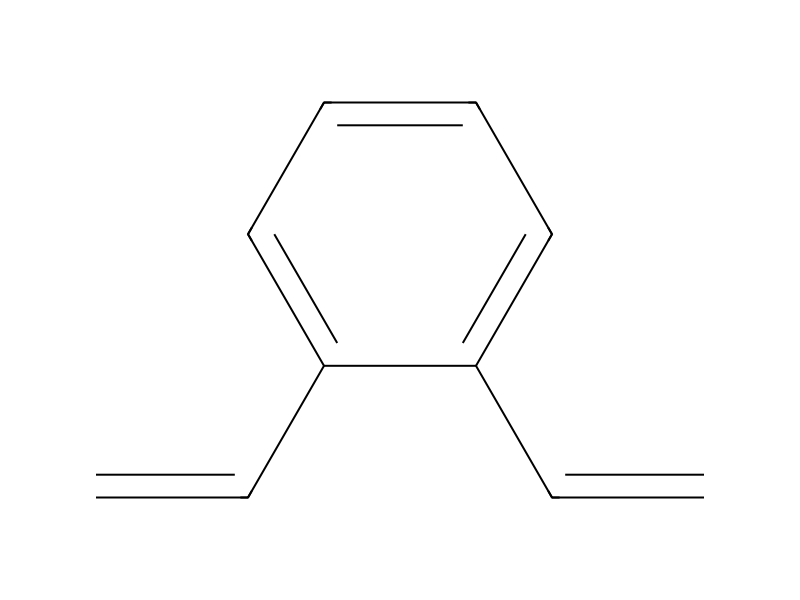

Product 1

Reagents, catalysts & solvents 1

Conditions
- Temperature
- 20 °C
Procedure
A styrene-divinylbenzene fine particle product was prepared by polymerization of 30 g. of styrene and 3 g. of 55% divinylbenzene in 250 ml. of hexane using 4.83 ml. of 1.18 N S-butyllithium as catalyst and 1.5 g. of the styrene-isoprene block copolymer dispersant of Example 4 under nitrogen. After 1.5 hours reflux the mixture was cooled to 20°C. and reacted with air followed by 0.36 ml. of acetic acid to convert the terminal lithium groups to hydroperoxide groups. The resulting mixture was then mixed with a solution of dimethyl silicone rubber dissolved in hexane (Gen. Elec. SE-76) and the mixture precipitated into methanol to give a masterbatch product containing 50 parts of filler per 100 parts of silicone rubber.
Workup
- temperatureAfter 1.5 hours reflux the mixture
- customreacted with air
- customthe mixture precipitated into methanol
- customto give a masterbatch product
Sources & evidence
- ORD record
- ord-b06e22282d3147e8886bccd929eaf301
- Source dataset
- uspto-grants-1976_05
- Patent number
- US03956419
Reaction notes
Loading…