Sodium Cyanide → 9-Acridinecarbonitrile, 2-chloro-
Reaction equation

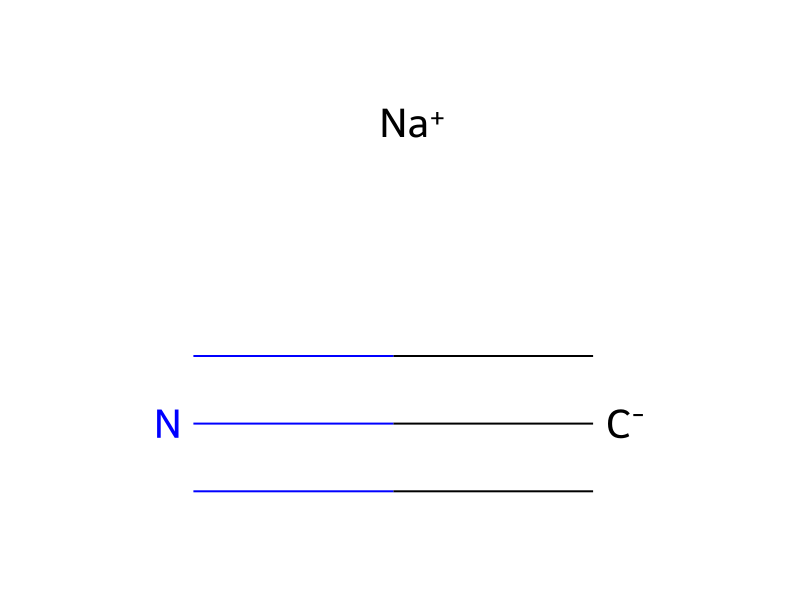
[Cl:1][C:2]1[CH:15]=[CH:14][C:13]2[C:4](=[C:5](Cl)[C:6]3[C:11]([N:12]=2)=[CH:10][CH:9]=[CH:8][CH:7]=3)[CH:3]=1.[C-:17]#[N:18].[Na+]>CO>[Cl:1][C:2]1[CH:15]=[CH:14][C:13]2[C:4](=[C:5]([C:17]#[N:18])[C:6]3[C:11]([N:12]=2)=[CH:10][CH:9]=[CH:8][CH:7]=3)[CH:3]=1Participants
4
Reactant 2

Product 1

Reagents, catalysts & solvents 1

Procedure
A mixture of 1 gm of 2,9-dichloroacridine [obtained by the process of Bogucka, Roczniki, Chem. Vol. 40 (1966) p 677]230 mg of sodium cyanide and 20 cc of methanol was heated for 4 hours at 140°C in a sealed tube and after cooling, the mixture was filtered. The precipitate was washed with acetone and dried. The product was purified by sublimation in vacuo at 0.1 mm Hg to obtain 530 mg of 2-chloro-9-cyano-acridine melting at 208°C.
Workup
- customobtained by the process of Bogucka, Roczniki, Chem
- temperatureafter cooling
- filtrationthe mixture was filtered
- washThe precipitate was washed with acetone
- customdried
- customThe product was purified by sublimation in vacuo at 0.1 mm Hg
Sources & evidence
- ORD record
- ord-805e343616a34b2c9b60c8f699a3d167
- Source dataset
- uspto-grants-1976_05
- Patent number
- US03957757
Reaction notes
Loading…