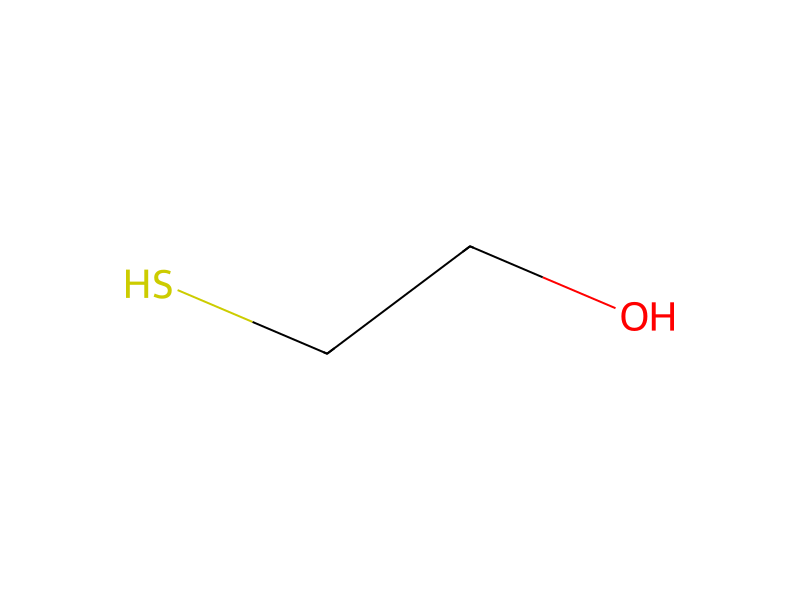
2-Mercaptoethanol → HCID 19430498, compound
Reaction equation

[Cl:1][C:2]1[CH:7]=[CH:6][C:5]([C:8](=[O:15])[CH2:9][N:10]2[CH:14]=[N:13][CH:12]=[N:11]2)=[CH:4][CH:3]=1.[SH:16][CH2:17][CH2:18]O.C1(C)C=CC(S(O)(=O)=O)=CC=1>C1(C)C=CC=CC=1.C(O)CCC.C1CCCCC1>[Cl:1][C:2]1[CH:7]=[CH:6][C:5]([C:8]2([CH2:9][N:10]3[CH:14]=[N:13][CH:12]=[N:11]3)[S:16][CH2:17][CH2:18][O:15]2)=[CH:4][CH:3]=1Participants
7






Procedure
To a slurry of 44.3 g 1-(4-chlorophenyl)-2-(1H-1,2,4-triazol-1-yl) ethanone in 800 ml dry toluene and 400 ml 1-butanol was added 31.2 g 2-mercaptoethanol and 51.0 g p-toluenesulfonic acid. The mixture was refluxed under a Dean-Stark trap for 48 hours. On cooling, a white solid precipitated out, which was removed by filtration. The filtrate was evaporated, the residue dissolved in dichloromethane and washed twice with 10% aqueous sodium hydroxide and once with water. The organic layer was dried, filtered and evaporated to leave an oil which was taken up in cyclohexane. The cyclohexane was evaporated to azeotrope off any remaining 1-butanol, leaving an oily solid which was triturated with petroleum ether to give 15.7 g of product.
Workup
- temperatureThe mixture was refluxed under a Dean-Stark trap for 48 hours
- temperatureOn cooling
- customa white solid precipitated out
- customwhich was removed by filtration
- customThe filtrate was evaporated
- dissolutionthe residue dissolved in dichloromethane
- washwashed twice with 10% aqueous sodium hydroxide and once with water
- customThe organic layer was dried
- filtrationfiltered
- customevaporated
- customto leave an oil which
- customThe cyclohexane was evaporated
- customleaving an oily solid which
- customwas triturated with petroleum ether
Sources & evidence
- ORD record
- ord-e193fd2e07704a1b86bee3abd88407c6
- Source dataset
- uspto-grants-1996_08
- Patent number
- US05545655
Reaction notes
Loading…