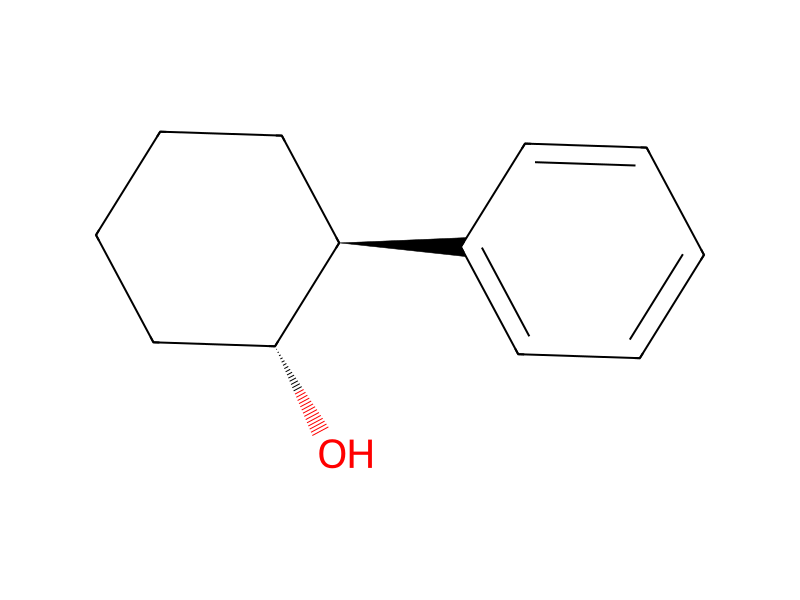
Dichloromethane → (-)-(1R,2S)-2-phenylcyclohexyl chloroacetate
Reaction equation

[C:1]1([C@@H:7]2[CH2:12][CH2:11][CH2:10][CH2:9][C@H:8]2[OH:13])[CH:6]=[CH:5][CH:4]=[CH:3][CH:2]=1.[Cl:14][CH2:15][C:16](Cl)=[O:17].C(Cl)Cl.CCCCCC.C(OCC)(=O)C>CN(C)C1C=CN=CC=1.OS(O)(=O)=O>[Cl:14][CH2:15][C:16]([O:13][C@@H:8]1[CH2:9][CH2:10][CH2:11][CH2:12][C@H:7]1[C:1]1[CH:6]=[CH:5][CH:4]=[CH:3][CH:2]=1)=[O:17]Participants
Reactant 4



Product 1

Reagents, catalysts & solvents 2


Procedure
A mixture of 2.17 k9 (12.3 mole) of (±)-trans-2-phenylcyclohexanol, 1475 mL (18.43 mole) of chloroacetyl chloride, 6 g (0.049 mole) of 4-dimethylaminopyridine, and 5.5 L of methylene chloride was heated at reflux. After 8 hours, thin layer chromatography analysis (4:1 hexane-ethyl acetate: Spray 5% NH4MoO4 in 10% aqueous H2SO4) indicated complete reaction. The reaction mixture was allowed to cool to room temperature and was stirred with 2×4 L=8 L of saturated NaHC03. The organic layer was dried (Na2SO4) evaporated in vacuo on a rotary evaporator, and finally at 0.5 mmHg to afford 3.21 kg of crude (±)-trans-2-phenylcyclohexyl chloroacetate. Distillation of the tan liquid afforded 2.76 kg (88%) of the desired product as a colorless liquid, (b.p. 125-133°/0.3-0.5 mmHg). The chloroacetylation of other lots of (±)-trans-2-phenylcyclohexanol was accomplished in ← 95%. The particular lot of (±) alcohol used in this example was only about 91% pure.
Workup
- temperaturewas heated
- temperatureat reflux
- customreaction
- dry with materialThe organic layer was dried (Na2SO4)
- customevaporated in vacuo on a rotary evaporator
Sources & evidence
- ORD record
- ord-aac699a17e9945028636047c5bd21dc8
- Source dataset
- uspto-grants-1991_04
- Patent number
- US05008411
Reaction notes
Loading…