HCID 178506791, Verbindung → tert-Butylstyrene
Reaktionsgleichung

[C:1]([C:5]([Li])=[CH:6][C:7]1[CH:12]=[CH:11][CH:10]=[CH:9][CH:8]=1)([CH3:4])([CH3:3])[CH3:2]>CO>[C:1]([CH:5]=[CH:6][C:7]1[CH:8]=[CH:9][CH:10]=[CH:11][CH:12]=1)([CH3:4])([CH3:2])[CH3:3]Komponenten


Reagenzien, Katalysatoren, Lösungsmittel 1
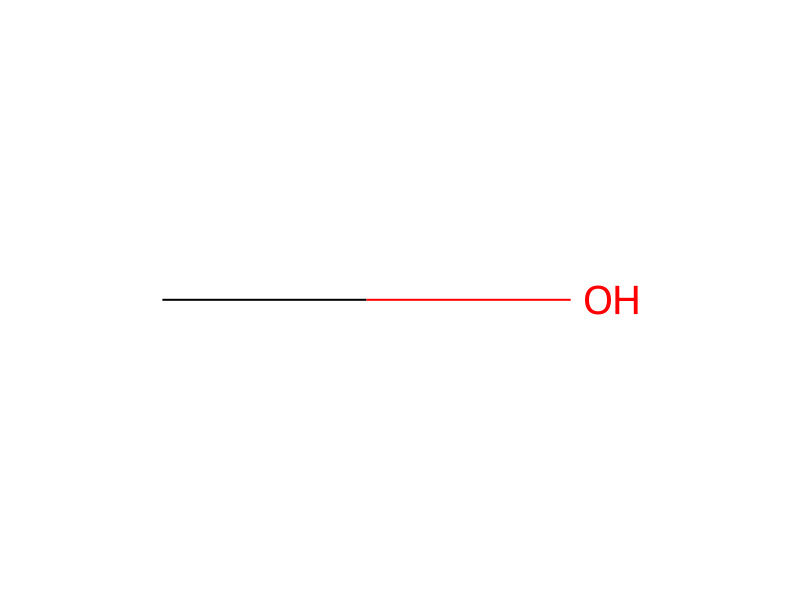
Versuchsvorschrift
To a dry, two-necked, 1-liter, round-bottomed flask were added 500 ml of dry cyclohexane under an inert argon atmosphere. The cyclohexane was then titrated for proton donating impurities, e.g., water, alcohol, etc., by the addition of 5×10⁻⁵ moles of 1,1-diphenylethylene. Sec-butyl lithium initiator (1.4M in hexane) was slowly added dropwise until a permanent faint yellow color became evident and this solution was stirred for one hour. The solution was then back-titrated with cyclohexane containing a trace amount of water until the yellow color disappeared. Under an inert argon atmosphere, 47.6 mls additional sec-butyl lithium initiator (1.4M in hexane) were then added to the flask. A water bath was placed under the flask and 114.9 g of dry t-butyl styrene were added to the flask. Polymerization began as evidenced by a reaction exotherm and the solution becoming bright red-orange in color due to carbanion formation. The reaction temperature rose to 60° C. and was held at 60° C for one hour to produce a deep red t-butyl styrene polymer solution. A 10-percent molar excess of methanol based on the sec-butyl lithium concentration used for polymerization was added to the solution and allowed to react to convert the t-butyl styryl lithium end groups at the terminal portions of the polymer chains to hydrogen atoms. The t-butyl styrene polymer was isolated by precipitation in methanol, washed with water, and vacuum dried to give a 95% yield of a dry, white, powdery solid having a number average molecular weight of 1200, a polydispersity index of 1.11, and a glass transition temperature of 65° C.
Aufarbeitung
- concentrationA 10-percent molar excess of methanol based on the sec-butyl lithium concentration
- customused for polymerization
- additionwas added to the solution
- customto react
Quellen und Nachweise
- ORD-Eintrag
- ord-76cdb64895394501bb55650d69b7ba47
- Quelldatensatz
- uspto-grants-1991_07
- Patentnummer
- US05028484
Notizen zur Reaktion
Wird geladen…