1,4-Dichlorobenzene → 1,2-Dichloro-3-(propan-2-yl)benzene
Reaction equation

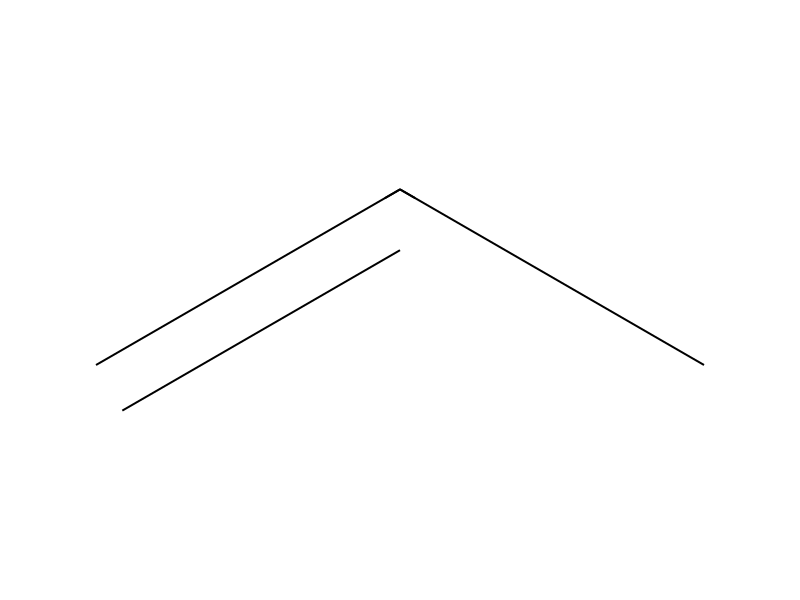
[CH2:1]=[CH:2][CH3:3].Cl[C:5]1[CH:10]=[CH:9][CH:8]=[C:7]([Cl:11])[CH:6]=1.C1C([Cl:18])=CC=C(Cl)C=1.[Al+3].[Cl-].[Cl-].[Cl-]>>[Cl:18][C:6]1[C:7]([Cl:11])=[C:8]([CH:2]([CH3:3])[CH3:1])[CH:9]=[CH:10][CH:5]=1Participants
5




Procedure
This experiment is carried out in the same manner as in Example 1, except that propylene is used instead of isopropyl bromide. A dry-ice condenser is used instead of coolant condenser and propylene is sparged below the liquid level through a sparger tube. Thus, 377.8 g (2.57 mole) of mixture consisting of 70% (264.6 g; 1.8 mole) m-dichlorobenzene, 30% (113.2 g; 0.77 mole) p-dichlorobenzene and 48.0 g (0.36 mole) AlCl3 are placed in a 4-neck, one-liter flask and to it 34 g (0.81 mole) propylene is sparged below the liquid level. The temperature of reaction mixture is kept below 10° C. After overnight isomerization, decomposition of the AlCl3 complex, the organic layer shows little alkylation: only 1 to 2% dichlorocumene is formed.
Workup
- customA dry-ice condenser is used instead of coolant condenser
- custompropylene is sparged below the liquid level through a sparger tube
- customThe temperature of reaction mixture
- customis kept below 10° C
Sources & evidence
- ORD record
- ord-e666a7408676466ca35b834d0fc8bd66
- Source dataset
- uspto-grants-1991_07
- Patent number
- US05030777
Reaction notes
Loading…