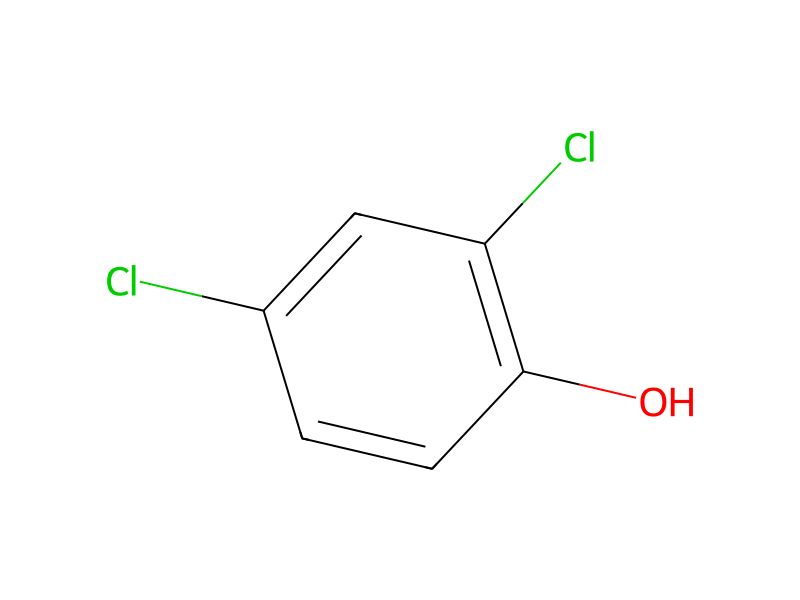
2,4-Dichlorophenol → HCID 820043, compound
Reaction equation

Cl[C:2]1[CH:7]=[C:6]([NH2:8])[N:5]=[C:4]([NH2:9])[N:3]=1.[Cl:10][C:11]1[CH:16]=[C:15]([Cl:17])[CH:14]=[CH:13][C:12]=1[OH:18].[OH-].[K+]>>[NH2:9][C:4]1[N:3]=[C:2]([O:18][C:12]2[CH:13]=[CH:14][C:15]([Cl:17])=[CH:16][C:11]=2[Cl:10])[CH:7]=[C:6]([NH2:8])[N:5]=1Participants



Procedure
First the substance of the formula (I) was synthetized from 4-chloro 2,6-diaminopyrimidine British patent specification No. 1,167,735; CA. 68, 21947h by heating the latter compound with 2,4-dichlorophenol at 150° C. in the presence of 85% aqueous potassium hydroxide solution to give 2,6-diamino-4-(2,4-dichlorophenoxy)pyrimidine. This substance was oxidized in a low yield to 6 amino 4-(2,4 dichlorophenoxy)-1,2-dihydro-1-hydroxy-2-iminopyrimidine, which was then transformed at 150° C. with piperidine to the target compound of the formula (I). The overall yield of this synthesis amounts to about 2.5% with a 45% yield in the last step. This is mainly caused by the fact that the replacement of the 2,4-dichlorophenoxy group by piperidine requires severe reaction conditions and long heating periods which favour unrequired side reactions, too.
Sources & evidence
- ORD record
- ord-59d931e06eae425b8915e75552054856
- Source dataset
- uspto-grants-1990_10
- Patent number
- US04960888
Reaction notes
Loading…