Hexanal → 2-Hexylcyclopentanone
Reaction equation

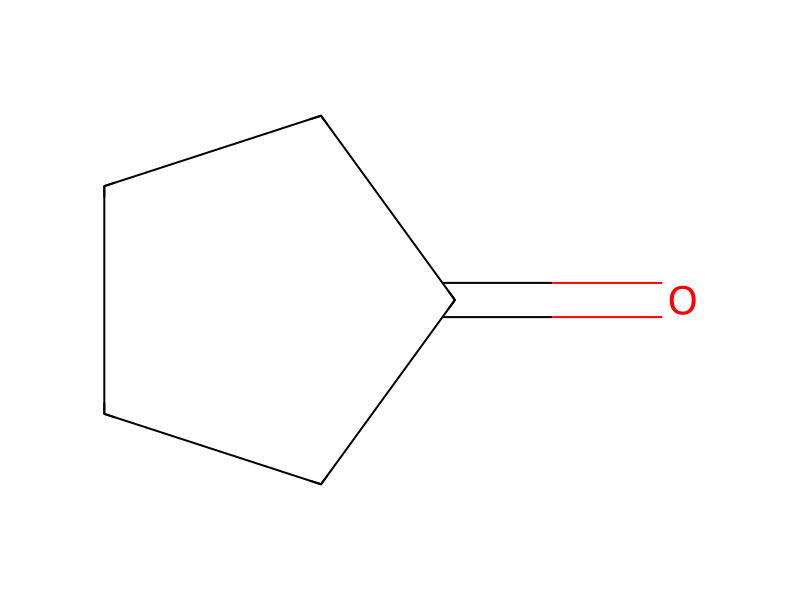
[C:1]1(=[O:6])[CH2:5][CH2:4][CH2:3][CH2:2]1.[CH:7](=O)[CH2:8][CH2:9][CH2:10][CH2:11][CH3:12]>[Pd]>[CH2:7]([CH:2]1[CH2:3][CH2:4][CH2:5][C:1]1=[O:6])[CH2:8][CH2:9][CH2:10][CH2:11][CH3:12]Participants
Reactant 2

Product 1

Reagents, catalysts & solvents 1

Procedure
A mixture of 1008 g (12 moles) of cyclopentanone, 800 g (8 moles) of n-hexanal and 80 g of a pulverulent catalyst containing 0.5% by weight of palladium on alumina was hydrogenated in an autoclave at 140° C. and under a hydrogen pressure of 70 bar until the pressure remained constant (about 15 hours), the procedure used being similar to that described in Example 1. The catalyst was separated off and the mixture discharged from the reactor was then distilled directly. 294 g (3.5 moles) of cyclopentanone were recovered as fraction 1. 1103 g of pure 2-hexylcyclopentanone (bp. 84° C./0.35 mbar) were obtained as the main fraction; this corresponded to a selectivity of 82%, based on n-hexanal. When, as in Example 1, the molar ratio of cyclopentanone to hexanal was increased to 3:1, the selectivity increased to above 90%, as in the case of 2-heptylcyclopentanone.
Workup
- customwas hydrogenated in an autoclave at 140° C. and under a hydrogen
- custom(about 15 hours)
- customThe catalyst was separated off
- distillationwas then distilled directly
Sources & evidence
- ORD record
- ord-08e1a2040a0b4eb9a62e490823bdb65b
- Source dataset
- uspto-grants-1992_01
- Patent number
- US05081309
Reaction notes
Loading…