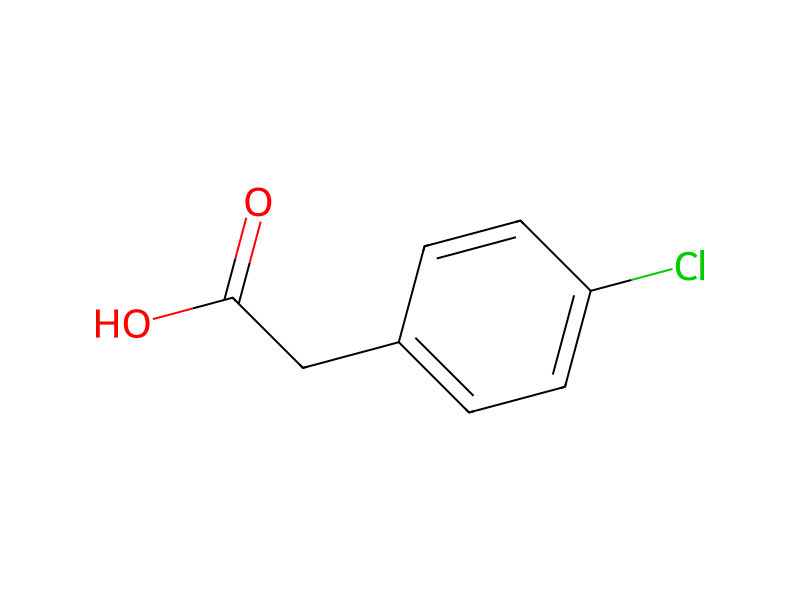
(4-Chlorophenyl)acetic acid → alpha-Bromo-4-chlorophenylacetic acid
Reaction equation

[Br:1]Br.[Cl:3][C:4]1[CH:9]=[CH:8][C:7]([CH2:10][C:11]([OH:13])=[O:12])=[CH:6][CH:5]=1>>[Br:1][CH:10]([C:7]1[CH:6]=[CH:5][C:4]([Cl:3])=[CH:9][CH:8]=1)[C:11]([OH:13])=[O:12]Participants


Procedure
In a stirred reactor with reflux condenser (connected to a caustic scrubber) 171 g 4-chlorophenyl acetic acid are pre-charged in 400 g chlorobenzene and heated to 105° C. Within 30 minutes 42 g thionyl chloride is added at 105-110° C. to form partly the acid chloride. To the reaction mixture 256 g bromine (1.6 mole) are added within 90 minutes at 105-108° C. The reaction mixture is stirred for another 2-3 hour at 105-108° C. until the conversion of the 4-chlorophenyl-acetic acid is complete (control by HPLC). Excess bromine is distilled off as a bromine/chlorobenzene mixture at 90° C. until a vacuum of 250 mbar is reached and the colour of the reaction mixture has changed from brown to yellow. The bromine distillate can be re-used in the next batch. The reaction mixture, containing a mix of bromo-(4-chloro-phenyl)acetic acid and acid chloride is diluted with chlorobenzene to a weight of 800 g and can directly be converted to (4-chloro-phenyl)-prop-2-ynyloxy-acetic acid according to Example 14.
Workup
- distillationExcess bromine is distilled off as a bromine/chlorobenzene mixture at 90° C. until a vacuum of 250 mbar
- additionThe reaction mixture, containing
- additiona mix of bromo-(4-chloro-phenyl)acetic acid and acid chloride
- additionis diluted with chlorobenzene to a weight of 800 g
Sources & evidence
- ORD record
- ord-0eaba3372dc743c7878fab1f0878572d
- Source dataset
- uspto-grants-2012_03
- Patent number
- US08129560B2
Reaction notes
Loading…