HuagongsheHuagongshe Chemistry Print Report · For research reference only
HRID 1097167Generated: October 25, 2026
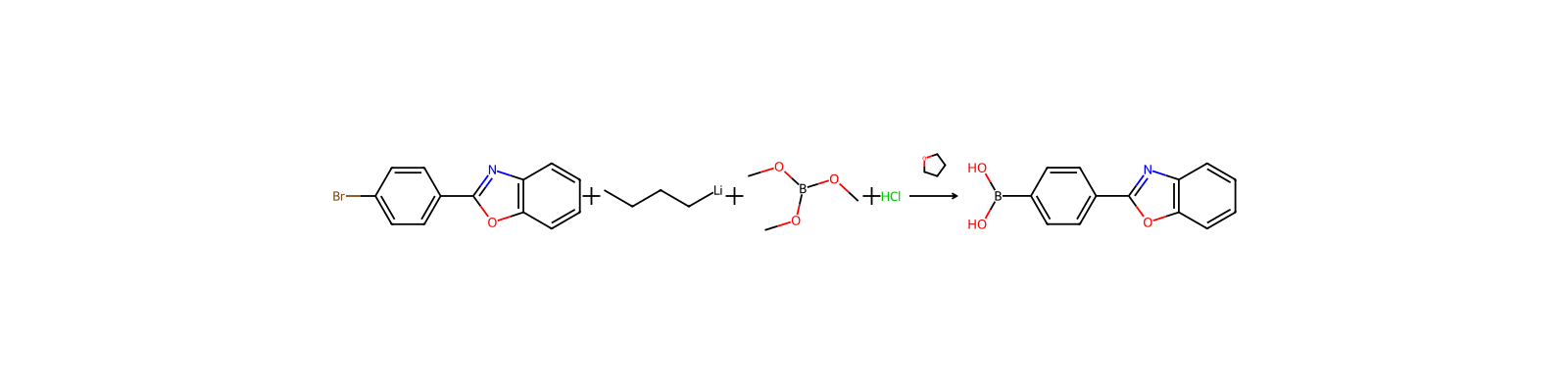
Hydrochloric Acid → (4-(Benzo[d]oxazol-2-yl)phenyl)boronic acid
https://huagongshe.com/reaction/1097167
Participants
| Role | Name | HCID | Charge |
|---|
| Reactant | Hydrochloric Acid | HCID 313 | — |
| Reactant | Trimethyl borate | HCID 8470 | — |
| Reactant | 2-(4-Bromophenyl)benzo(d)oxazole | HCID 12846715 | — |
| Reactant | Butyllithium | HCID 178418339 | — |
| Solvent | Tetrahydrofuran | HCID 8028 | — |
| Product | (4-(Benzo[d]oxazol-2-yl)phenyl)boronic acid | HCID 57958561 | — |
Reaction Steps
First, 5.5 g (20 mmol) of 2-(4-bromophenyl)benzoxazole was put into a 300 mL three-neck flask and the atmosphere in the flask was substituted by nitrogen. 120 mL of THF was added and cooled to −78° C. under a nitrogen stream. After cooling, 13 mL (22 mmol) of 1.6 M n-butyllithium was dripped to this solution, and the mixture was stirred at the same temperature for 2 hours. After a certain time, 4.4 mL (40 mmol) of trimethyl borate was added to this solution, and the temperature of the solution was raised to room temperature, and then, the solution was stirred for 16 hours. After a certain time, 100 mL of 1M hydrochloric acid was added and stirred for 1 hour. An aqueous layer of the obtained mixture was extracted with ethyl acetate. The obtained extract was washed with a saturated saline together with the organic layer and then dried over magnesium sulfate. The obtained mixture was subjected to gravity filtration, and the obtained filtrate was concentrated to give a solid. The obtained solid was recrystallized with ethyl acetate/hexane, so that 3.3 g of target white powder was obtained with a yield of 69%.
Provenance & Evidence
| DOI | 10.6084/m9.figshare.5104873.v1 |
|---|
| Patent number | US08142911B2 |
|---|
| Source dataset | uspto-grants-2012_03 |
|---|
| ORD ID | ord-72a8be1e2ded4c17a1735cbd119ffdec |
|---|
| Source note | uspto-grants-2012_03 |
|---|