Dichloromethane → 5-amino-1-(2-bromo-6-chlorophenyl)-1H-pyrazole-4-carbonitrile
Reaction equation

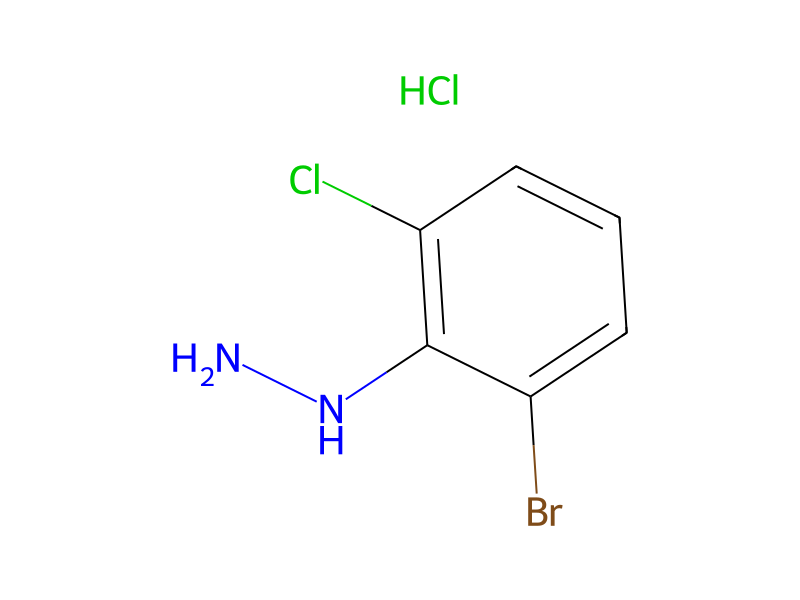
Cl.[Br:2][C:3]1[CH:8]=[CH:7][CH:6]=[C:5]([Cl:9])[C:4]=1[NH:10][NH2:11].C(Cl)Cl.[OH-].[Na+].C(O[CH:20]=[C:21]([C:24]#[N:25])[C:22]#[N:23])C>CO>[NH2:25][C:24]1[N:10]([C:4]2[C:5]([Cl:9])=[CH:6][CH:7]=[CH:8][C:3]=2[Br:2])[N:11]=[CH:20][C:21]=1[C:22]#[N:23]Participants
Reactant 4



Product 1

Reagents, catalysts & solvents 1

Procedure
(2-Bromo-6-chlorophenyl)hydrazine hydrochloride (Intermediate AH2) (4.71 g, 18.26 mmol) was partitioned between DCM (300 mL) and 2M NaOH (20 mL). Allowed to Stir for 1 hour. The two phases were separated. The organic phase was reduced under vacuum to give the free base. This was dissolved in MeOH (60 mL), and stirred in a cooling bath at 0° C. (Ethoxymethylene)malononitrile (2.230 g, 18.26 mmol) added portionwise. The reaction mixture was then allowed to warm to ambient temperature and stirred for 1 hour. The mixture was then heated to reflux and stirred for 16 hours. Allowed to cool to ambient temperature. The reaction mixture was concentrated to give a solid, which was triturated under MeOH. A solid was filtered off. This was dried to afford the product (4.59 g, 85%).
Workup
- customThe two phases were separated
- customto give the free base
- additionadded portionwise
- stirringstirred for 1 hour
- temperatureThe mixture was then heated
- temperatureto reflux
- stirringstirred for 16 hours
- temperatureAllowed to cool to ambient temperature
- concentrationThe reaction mixture was concentrated
- customto give a solid, which
- customwas triturated under MeOH
- filtrationA solid was filtered off
- customThis was dried
Sources & evidence
- ORD record
- ord-663a6e92740a46eb974d4d6c0a125b51
- Source dataset
- uspto-grants-2012_03
- Patent number
- US08143263B2
Reaction notes
Loading…