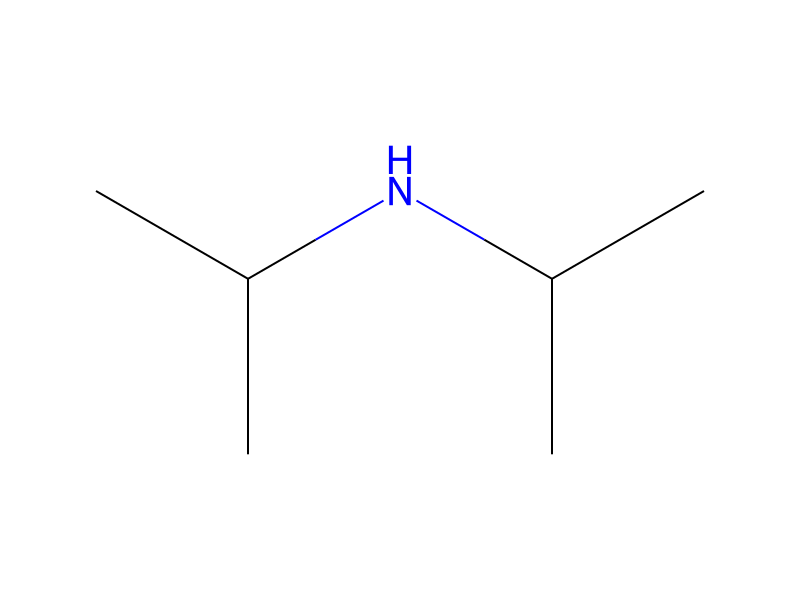
Diisopropylamine → o-Fluorobenzaldehyde
Reaction equation

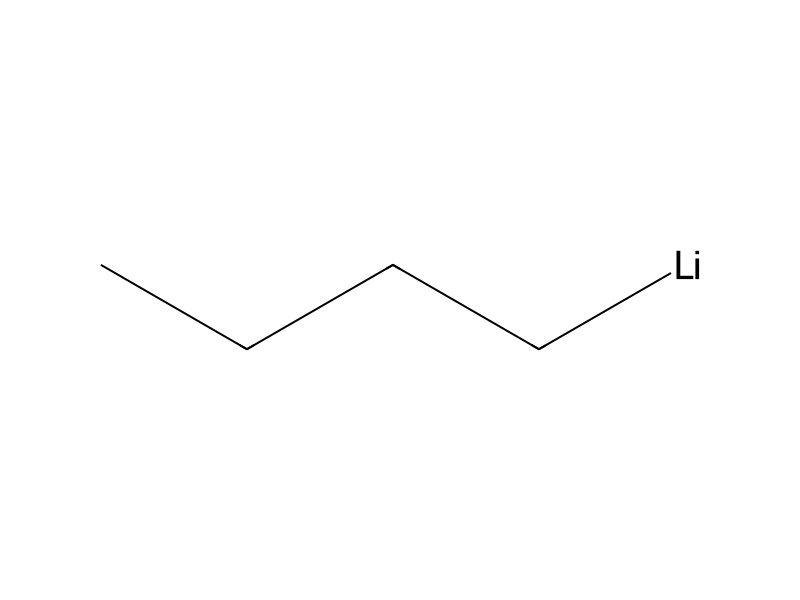
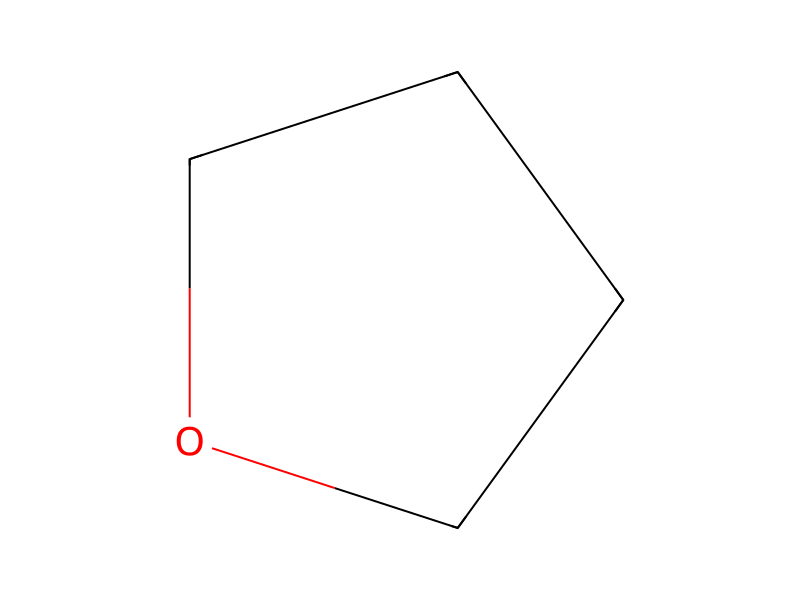
C(NC(C)C)(C)C.C([Li])CCC.ClC1C=CC=CC=1N1C(=O)C2C(=CC=C(F)C=2)N=C1C.C[C:34]1[C:35]([F:42])=[C:36]([CH:39]=[CH:40][CH:41]=1)[CH:37]=[O:38]>O1CCCC1>[F:42][C:35]1[CH:34]=[CH:41][CH:40]=[CH:39][C:36]=1[CH:37]=[O:38]Participants



Conditions
- Temperature
- -78 °C
Procedure
A solution of diisopropylamine (0.60 mL, 4.57 mmol) in tetrahydrofuran (27 mL) was chilled to -78° C. and butyllithium (1.30 mL, 3.25 mmol, 2.5 N in hexanes) was added dropwise. The solution was stirred 10 minutes and then a solution 3-(2-chloro-phenyl)-6-fluoro-2-methyl-3H-quinazolin-4-one (1.04 g, 3.60 mmol) in tetrahydrofuran (7 mL) was added dropwise. The solution became intense red and was stirred 30 minutes. In a separate vessel a solution of 2-fluorobenzaldehyde (0.575 mL, 6.33 mmol) in tetrahydrofuran (20 mL) was prepared and chilled to -78 ° C. The cold red anion solution was added to the cold methyl 2-fluorobenzaldehyde solution via canula over 30 seconds. The resulting mixture was stirred 1 hour at -78° C. and then quenched with saturated aqueous bicarbonate and warmed to ambient temperature. The mixture was concentrated and the residue was diluted with water (50 mL), ethyl acetate (10 mL) and saturated aqueous sodium bisulfite (50 mL). This mixture was stirred 1 h and then repeatedly extracted with ethyl acetate. The combined extracts were washed with water and brine, dried over magnesium sulfate and concentrated. The residues from the two side by side reactions were combined and flash chromatographed on silica gel (45×150 mm) with elution proceeding as follows: 20% ethyl acetate/hexane (500 mL), nil; 30% ethyl acetate/hexane (500 mL) and 40% ethyl acetate/hexane (500 mL), two diastereomers of 3-(2-chloro-phenyl)-6-fluoro-2-[2-(2-fluoro-phenyl)-2-hydroxy-ethyl]-3H-quinazolin-4-one, both as viscous oils. The faster eluting diastereomer weighed 0.231 g (17%) and had: 1H NMR δ7.92 (dd, J=3, 8.5 Hz, 1 H), 7.77 (dd, J=5, 9 Hz, 1 H), 7.60 (dd, J=1.5, 7.5 Hz, 1 H), 7.57-7.55 (m, 1 H), 7.53 (dd, J=3,8 Hz, 1 H), 7.48-7.42 (sym m, 2 H), 7.36-7.31 (m, 1 H), 7.24-7.18 (m,1 H), 7.12 (t, J=7.5 Hz, 1 H), 6.96-6.90 (m, 1 H), 5.65 (br s, 1 H), 5.55 (dd, J=2.5, 9 Hz, 1 H), 2.70 (dd, J=2.5, 17 Hz, 1 H), 2.61 (dd, J=9, 17 Hz, 1 H). The slower eluting diastereomer weighed 0.283 g (21%) and had: 1H NMR δ7.91 (dd, J=3, 9 Hz, 1 H), 7.76 (dd, J=5, 9 Hz, 1 H), 7.58 (dd, J=1.5, 8 Hz, 1 H), 7.54 (dd, J=3, 9 Hz, 1 H), 7.51 (dd, J=1.5, 8 Hz, 1 H), 7.44 (dt, J=2, 8 Hz, 1 H), 7.39 (dt, J=1.5, 8 Hz, 1 H), 7.23-7.17 (m, 1 H), 7.13-7.07 (m, 2 H), 6.98-6.91 (m, 1 H), 5.61 (br s, 1 H), 5.57 (dd, J=4, 8 Hz, 1 H), 2.72-2.60 (m, 2 H).
Workup
- stirringwas stirred 30 minutes
- stirringThe resulting mixture was stirred 1 hour at -78° C.
- customquenched with saturated aqueous bicarbonate
- temperaturewarmed to ambient temperature
- concentrationThe mixture was concentrated
- additionthe residue was diluted with water (50 mL), ethyl acetate (10 mL) and saturated aqueous sodium bisulfite (50 mL)
- stirringThis mixture was stirred 1 h
- extractionrepeatedly extracted with ethyl acetate
- washThe combined extracts were washed with water and brine
- dry with materialdried over magnesium sulfate
- concentrationconcentrated
- customflash chromatographed on silica gel (45×150 mm) with elution proceeding
- washThe faster eluting diastereomer
- washThe slower eluting diastereomer
Sources & evidence
- ORD record
- ord-6dedee4f0cb6484f84591e867df20df9
- Source dataset
- uspto-grants-2000_05
- Patent number
- US06060479
Reaction notes
Loading…