Formaldehyde → alpha-Hydroxymethyl-alpha-fluoromalonic acid
Reaction equation

[F:1][CH:2]([C:7]([O:9]C)=[O:8])[C:3]([O:5]C)=[O:4].C=O.FF.FC(C([O-])=O)[C:17]([O-])=[O:18].C1N2CN3CN(C2)CN1C3.O1COCOC1.C(=O)([O-])O.[K+].C(=O)([O-])O.[Na+]>>[OH:18][CH2:17][C:2]([F:1])([C:7]([OH:9])=[O:8])[C:3]([OH:5])=[O:4]Participants






Procedure
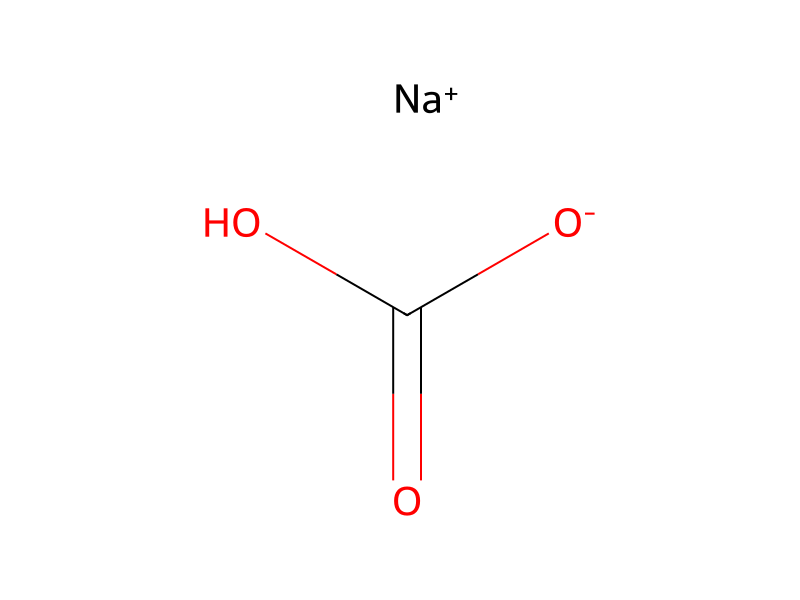
In the first process step, dimethyl α-fluoromalonate is subjected to a hydroxymethylation with formaldehyde. (Dimethyl α-fluoromalonate is a known compound; see Journal of Fluorine Chemistry 25 (1984), 203-212.) The formaldehyde is preferably used in the form of an aqueous solution which has a formaldehyde content of 30 to 40 percent by weight. The formaldehyde is used in an amount of 1 to 10 moles, preferably 1.1 to 3 moles (based on 1 mole of dimethyl o,-fluoromalonate). Instead of formaldehyde, it is also possible to use paraformaldehyde, hexamethylenetetramine or 1,3,5-trioxane. It is advantageous to carry out the reaction in the presence of a basic catalyst which is then used in an amount of 2 to 50, preferably 5 to 15, mol % (based on dimethyl α-fluoromalonate). The catalyst used is in particular an alkali metal hydrogencarbonate, for example potassium hydrogencarbonate and sodium hydrogencarbonate. The reaction is carried out at a temperature of 5° to 40° C., preferably of 15 ° to 30° C. The resulting dimethyl ester of α-hydroxymethyl-α-fluoromalonic acid is then isolated out of the reaction mixture, preferably by salting out or extraction by means of a water-nonmiscible organic solvent. A suitable solvent is in particular an aliphatic chlorohydrocarbon having 1 to 4 carbon atoms, for example dichloromethane, trichloromethane, tetrarhloromethane, 1,1-dichloroethane, 1,2-dichloroethane. A combination of salting out and extraction is particularly advantageous; therein the reaction mixture has first added to it a saturated salt solution (ammonium sulfate, sodium chloride), and this mixture is then extracted. By evaporating the solvent, α-hydroxymethyl-α-fluoromalonic acid is obtained as a colorless solid.
Workup
- customthe reaction in the presence of a basic catalyst which
- customis carried out at a temperature of 5° to 40° C., preferably of 15 ° to 30° C
Sources & evidence
- ORD record
- ord-7de85a3d3e804f639ab443c2247446ce
- Source dataset
- uspto-grants-1994_06
- Patent number
- US05319131
Reaction notes
Loading…