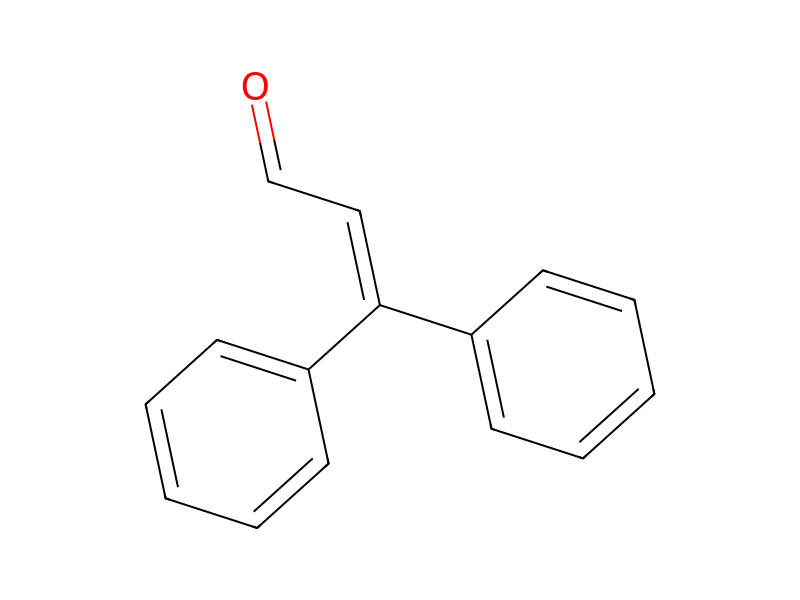
3,3-Diphenylacrolein → HCID 86742560, compound
Reaction equation

[C:1]1([C:7]([C:11]2[CH:16]=[CH:15][CH:14]=[CH:13][CH:12]=2)=[CH:8][CH:9]=O)[CH:6]=[CH:5][CH:4]=[CH:3][CH:2]=1.[C:17]([CH2:22][CH:23]=P(C1C=CC=CC=1)(C1C=CC=CC=1)C1C=CC=CC=1)([O:19][CH2:20][CH3:21])=[O:18]>C(O)C>[CH2:20]([O:19][C:17](=[O:18])/[C:22](/[CH3:23])=[CH:9]/[CH:8]=[C:7]([C:11]1[CH:16]=[CH:15][CH:14]=[CH:13][CH:12]=1)[C:1]1[CH:6]=[CH:5][CH:4]=[CH:3][CH:2]=1)[CH3:21]Participants
Reactant 2

Product 1

Reagents, catalysts & solvents 1

Procedure
As in the Example 99, a solution of 3,3-diphenyl-2-propenal (2.08 g) in ethanol (25 mL) was reacted with (carbethoxyethylidene)triphenylphosphine (4.0 g) for 30 minutes at room temperature. The reaction was worked up in the usual manner to give 2.8 g of (E)-5,5-diphenyl-2-methyl-2,4-pentadienoic acid ethyl ester as the sole product. The crude ester (2.89) in methanol (25 mL) was treated with 2N potassium hydroxide (10 mL) and the mixture was heated at reflux until the oil dissolved. Then it was cooled and left at ambient temperature overnight. The reaction was diluted with water (20 mL) and most of the methanol was removed under reduced pressure. The solution was acidified with 2N hydrochloric acid (12 mL) and the resulting solid was recovered by filtration washed with water and dried. The crude acid was triturated with hot hexane to furnish 2.08 g of (E)-5,5-diphenyl-2-methyl-2,4-pentadienoic acid. mp 184°-186° C. A sample was crystallized from 2-propanol to afford the analytical specimen. mp 185°-186.5° C. Anal. Calculated for C18H16O2 : C, 81.79; H. 6.10 Found: C, 81.73; H. 6.17.
Sources & evidence
- ORD record
- ord-259e8bc835654a5ead46fb1edbc92c26
- Source dataset
- uspto-grants-1990_12
- Patent number
- US04975438
Reaction notes
Loading…