Isophorone diisocyanate → Isophorone diamine
Reaction equation

[N:1]([CH:4]1[CH2:9][C:8]([CH3:11])([CH3:10])[CH2:7][C:6]([CH2:13][N:14]=C=O)([CH3:12])[CH2:5]1)=C=O>C1(C)C=CC=CC=1>[NH2:1][CH:4]1[CH2:9][C:8]([CH3:10])([CH3:11])[CH2:7][C:6]([CH2:13][NH2:14])([CH3:12])[CH2:5]1Participants
Reactant 1
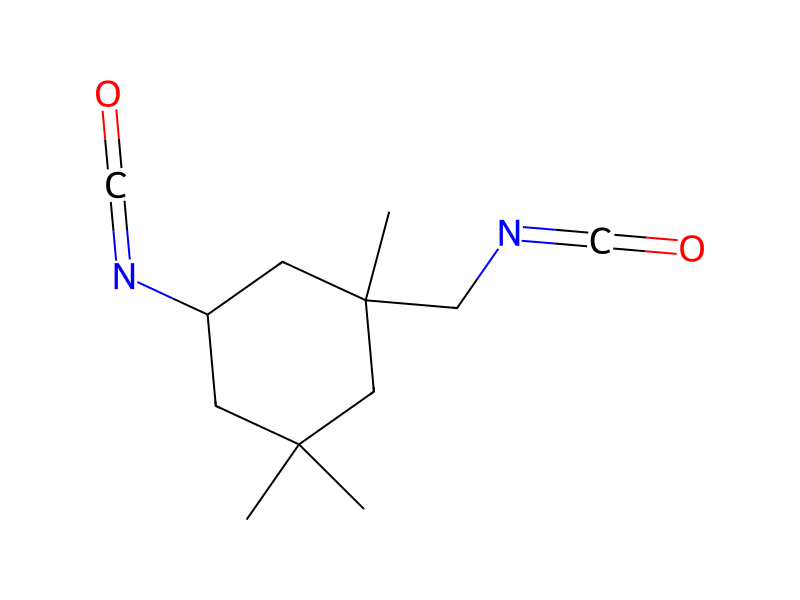
Product 1

Reagents, catalysts & solvents 1

Procedure
In the same apparatus as described in Example 1, a preadduct is produced from 67.03 parts, by weight, of a polyester of adipic acid and 1,4-butane diol (hydroxyl number 52.2; acid number 0.6), 3.06 parts, by weight, of a polydimethyl siloxane containing terminal methylol groups and having a hydroxyl number of 198.0 and 24.06 parts, by weight, of 1-isocyanato-3-isocyanatomethyl-3,5,5-trimethylcyclohexane by heating the mixture for 2.5 hours at 100° C. After dilution with 141.5 parts, by weight, of toluene, the solution is maintained at a temperature of 80° C. The mixture is then reacted to form the polyurethane in the same way as in Example 1, 1.49 kg/h of 1-amino-3-aminomethyl-3,5,5-trimethyl cyclohexane being additionally introduced as further reaction component into the reaction mixture in a pinned-disc mixer following the preheater and the reactor being heated using steam under a pressure of 25 bars. A 25% solution in toluene-isopropanol (1:1) prepared immediately after production of the reaction product has a viscosity of 6390 cP/20° C. After storage for 1 week at room temperature, the final viscosity amounts to 7250 cP/20° C.
Workup
- customThe mixture is then reacted
Sources & evidence
- ORD record
- ord-4364fff87dd44392bfb2d5dcb5bd8821
- Source dataset
- uspto-grants-1978_10
- Patent number
- US04119613
Reaction notes
Loading…