HuagongsheHuagongshe Chemistry Print Report · For research reference only
HRID 11225Generated: October 26, 2026
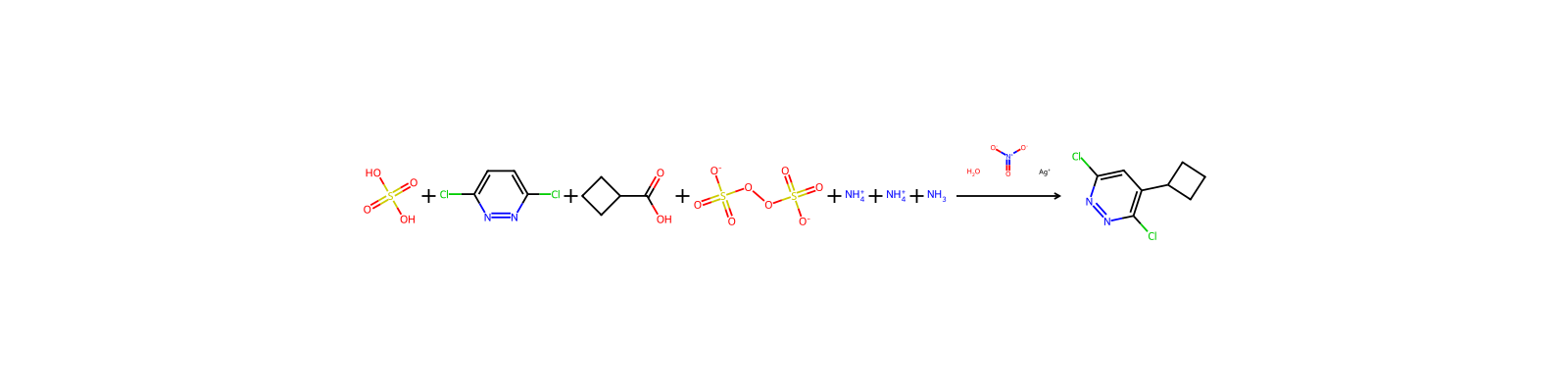
Ammonia → 3,6-Dichloro-4-cyclobutylpyridazine
https://huagongshe.com/reaction/11225
Participants
| Role | Name | HCID | Charge |
|---|
| Reactant | Ammonia | HCID 222 | — |
| Reactant | Sulfuric Acid | HCID 1118 | — |
| Reactant | Cyclobutanecarboxylic acid | HCID 19494 | — |
| Reactant | Ammonium Persulfate | HCID 62648 | — |
| Reactant | 3,6-Dichloropyridazine | HCID 67331 | — |
| Catalyst | Silver Nitrate | HCID 24470 | — |
| Solvent | Water | HCID 962 | — |
| Product | 3,6-Dichloro-4-cyclobutylpyridazine | HCID 21973219 | 82% |
Reaction Steps
Concentrated sulphuric acid (53.6 ml, 1.0 mol) was added carefully to a stirred suspension of 3,6-dichloropyridazine (50.0 g, 0.34 mol) in water (1.25 l). This mixture was then heated to 70° C. (internal temperature) before the addition of cyclobutane carboxylic acid (35.3 ml, 0.37 mol). A solution of silver nitrate (11.4 g, 0.07 mol) in water (20 ml) was then added over approximately one minute. This caused the reaction mixture to become milky in appearance. A solution of ammonium persulphate (230 g, 1.0 mol) in water (0.63 l) was then added over 20–30 minutes. The internal temperature rose to approximately 85° C. During the addition the product formed as a sticky precipitate. Upon complete addition the reaction was stirred for an additional 5 minutes, then allowed to cool to room temperature. The mixture was then poured onto ice and basified with concentrated aqueous ammonia, with the addition of more ice as required to keep the temperature below 10° C. The aqueous phase was extracted with dichloromethane (×3). The combined extracts were dried (MgSO4), filtered and evaporated to give the title compound (55.7 g, 82%) as an oil. 1H nmr (CDCl3) indicated contamination with approximately 5% of the 4,5-dicyclobutyl compound. However, this material was used without further purification. Data for the title compound: 1H NMR (360 MHz, d6-DMSO) δ1.79–1.90 (1H, m), 2.00–2.09 (1H, m), 2.18–2.30 (2H, m), 2.33–2.40 (2H, m), 3.63–3.72 (1H, m), 7.95 (1H, s); MS (ES+) m/e 203 [MH]+, 205 [MH]+, 207 [MH]+.
Provenance & Evidence
| DOI | 10.6084/m9.figshare.5104873.v1 |
|---|
| Patent number | US07098208B2 |
|---|
| Source dataset | uspto-grants-2006_08 |
|---|
| ORD ID | ord-60599b28a97246d789c0834951f8bbc5 |
|---|
| Source note | uspto-grants-2006_08 |
|---|