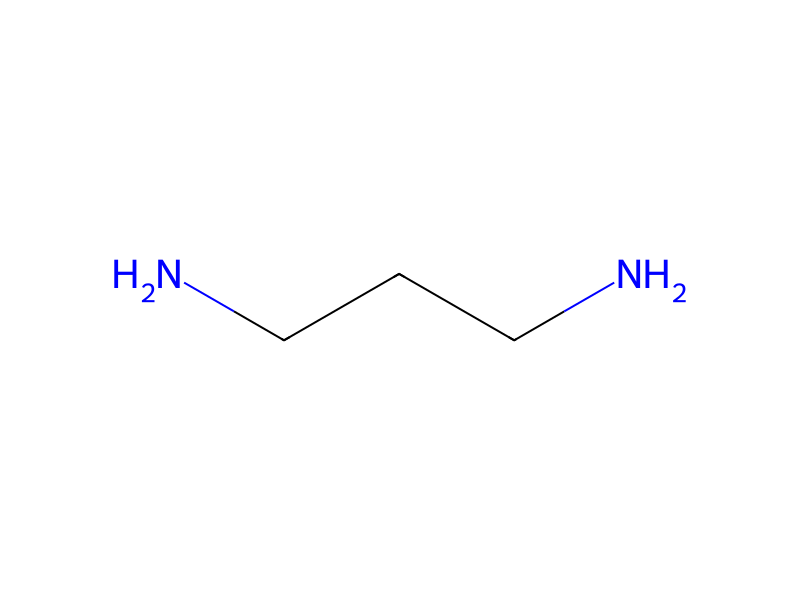
1,3-Propanediamine → N~1~-[1-(Pyridin-4-yl)ethyl]propane-1,3-diamine
Reaction equation

[C:1]([C:4]1[CH:9]=[CH:8][N:7]=[CH:6][CH:5]=1)(=O)[CH3:2].[NH2:10][CH2:11][CH2:12][CH2:13][NH2:14].O>C1(C)C=CC=CC=1>[N:7]1[CH:8]=[CH:9][C:4]([CH:1]([NH:10][CH2:11][CH2:12][CH2:13][NH2:14])[CH3:2])=[CH:5][CH:6]=1Participants
Reactant 3


Product 1

Reagents, catalysts & solvents 1

Procedure
4-Acetylpyridine (30.3 g) was added portionwise over 40 minutes to a solution of 1,3-diaminopropane (85 cm3) in toluene (250 cm3) under reflux, with continuous removal of water using a Dean and Stark trap. When no more water was observed in the toluene layer (3 hours) the mixture was concentrated in vacuo and the residue was taken into methanol (200 cm3) and treated with sodium borohydride (12.0 g) added portionwise over 20 minutes at 0° C. After stirring for 16 hours concentrated hydrochloric acid (10 cm3) was slowly added and the mixture was concentrated in vacuo. The residue was dissolved in water (100 cm3) and basified to pH11 with 5M sodium hydroxide solution. The mixture was extracted with chloroform (3×300 cm3) and the dried (MgSO4) extracts were evaporated in vacuo. Distillation gave N-[1-(4-pyridyl)ethyl]-1,3-diaminopropane (22.7 g) as a colourless oil, b.p. 108°-114°/0.03 mm.
Workup
- concentrationwas concentrated in vacuo
- additiontreated with sodium borohydride (12.0 g)
- additionadded portionwise over 20 minutes at 0° C
- additionwas slowly added
- concentrationthe mixture was concentrated in vacuo
- dissolutionThe residue was dissolved in water (100 cm3)
- extractionThe mixture was extracted with chloroform (3×300 cm3)
- dry with materialthe dried (MgSO4) extracts
- customwere evaporated in vacuo
- distillationDistillation
Sources & evidence
- ORD record
- ord-e7c272ba9b224845b20a77715d99926a
- Source dataset
- uspto-grants-1984_12
- Patent number
- US04489075
Reaction notes
Loading…