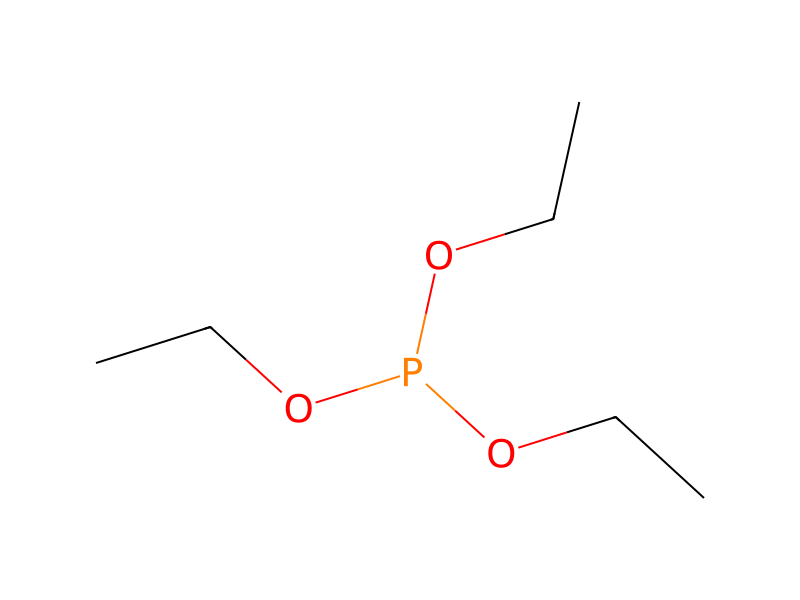
Triethyl phosphite → Diethyl (2,4,6-trimethylbenzoyl)phosphonate
Reaction equation

[CH3:1][C:2]1[CH:10]=[C:9]([CH3:11])[CH:8]=[C:7]([CH3:12])[C:3]=1[C:4](Cl)=[O:5].[P:13]([O:20]CC)([O:17][CH2:18][CH3:19])[O:14][CH2:15][CH3:16]>>[CH3:1][C:2]1[CH:10]=[C:9]([CH3:11])[CH:8]=[C:7]([CH3:12])[C:3]=1[C:4]([P:13](=[O:20])([O:17][CH2:18][CH3:19])[O:14][CH2:15][CH3:16])=[O:5]Participants
3


Conditions
- Temperature
- 80 °C
Procedure
91 parts of 2,4,6-trimethylbenzoyl chloride are introduced into an apparatus as described in Example 1. 83 parts of triethyl phosphite are added in the course of 15 minutes at 60° C., after which the mixture is stirred for 8 hours at 80° C. The material discharged from the flask is distilled under a pressure of 0.4 mm and the fraction boiling at 120°-122° C. under this pressure is collected. 51 parts (36 percent of theory) of diethyl 2,4,6-trimethylbenzoylphosphonate are obtained as a pale yellowish liquid.
Workup
- distillationis distilled under a pressure of 0.4 mm
- customthe fraction boiling at 120°-122° C. under this pressure is collected
Sources & evidence
- ORD record
- ord-da006672f84140d0972deca8db5f1a2c
- Source dataset
- uspto-grants-1981_11
- Patent number
- US04298738
Reaction notes
Loading…