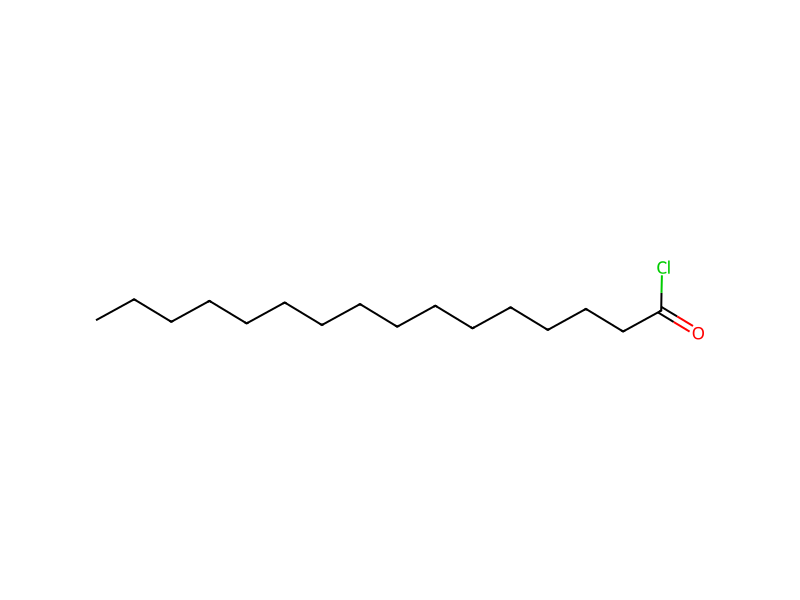
Palmitoyl chloride → Ethyl 3-fluoro-4-(hexadecanoylamino)benzoate
Reaction equation

[C:1](Cl)(=[O:17])[CH2:2][CH2:3][CH2:4][CH2:5][CH2:6][CH2:7][CH2:8][CH2:9][CH2:10][CH2:11][CH2:12][CH2:13][CH2:14][CH2:15][CH3:16].[NH2:19][C:20]1[CH:30]=[CH:29][C:23]([C:24]([O:26][CH2:27][CH3:28])=[O:25])=[CH:22][C:21]=1[F:31]>C(Cl)Cl>[F:31][C:21]1[CH:22]=[C:23]([CH:29]=[CH:30][C:20]=1[NH:19][C:1](=[O:17])[CH2:2][CH2:3][CH2:4][CH2:5][CH2:6][CH2:7][CH2:8][CH2:9][CH2:10][CH2:11][CH2:12][CH2:13][CH2:14][CH2:15][CH3:16])[C:24]([O:26][CH2:27][CH3:28])=[O:25]Participants
4
Reactant 2

Product 1

Reagents, catalysts & solvents 1

Procedure
A solution of hexadecanoyl chloride (20 g) in 100 ml of methylene chloride is slowly added with stirring to a solution of 20 g of ethyl 4-amino-3-fluorobenzoate in 100 ml of methylene chloride. The mixture is filtered and the filtrate is washed with dilute hydrochloric acid and water, dried and the solvent evaporated. Crystallization of the residue from acetonitrile affords ethyl 3-fluoro-4-(hexadecanoylamino)benzoate.
Workup
- filtrationThe mixture is filtered
- washthe filtrate is washed with dilute hydrochloric acid and water
- customdried
- customthe solvent evaporated
- customCrystallization of the residue from acetonitrile
Sources & evidence
- ORD record
- ord-bf29e2917c8a4844beaabe6d3283011f
- Source dataset
- uspto-grants-1982_06
- Patent number
- US04333940
Reaction notes
Loading…