HuagongsheHuagongshe Chemistry Print Report · For research reference only
HRID 1156472Generated: October 26, 2026
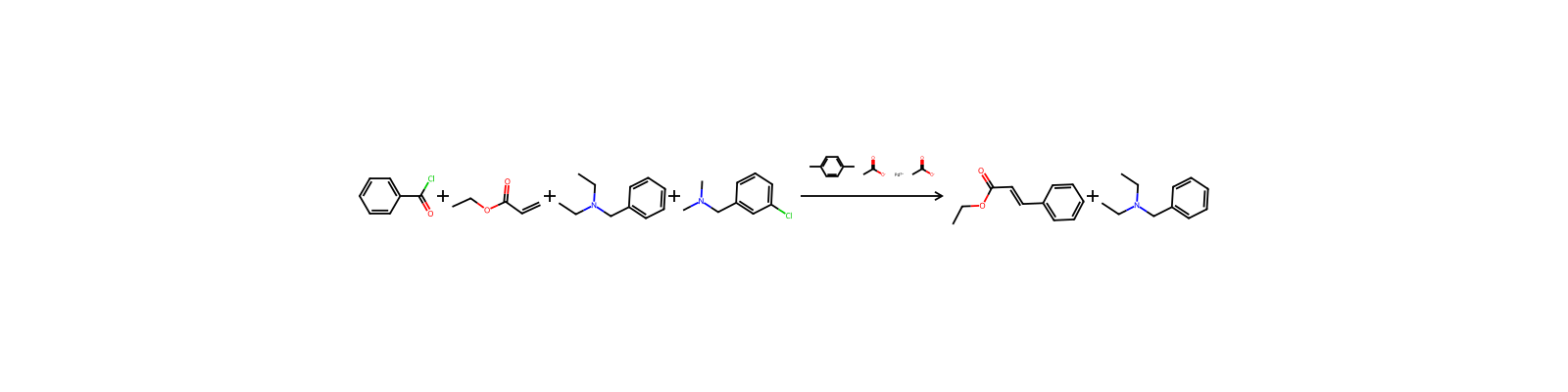
Benzoyl chloride → Ethyl 3-phenylprop-2-enoate
https://huagongshe.com/reaction/1156472
Participants
| Role | Name | HCID | Charge |
|---|
| Reactant | Benzoyl chloride | HCID 7412 | — |
| Reactant | Ethyl Acrylate | HCID 8821 | — |
| Reactant | Benzenemethanamine, N,N-diethyl- | HCID 61211 | — |
| Reactant | 3-Chloro-N,N-dimethylbenzenemethanamine | HCID 12617447 | — |
| Catalyst | palladium(II) acetate | HCID 167845 | — |
| Solvent | P-Xylene | HCID 7809 | — |
| Product | Ethyl 3-phenylprop-2-enoate | HCID 7649 | — |
| Product | Benzenemethanamine, N,N-diethyl- | HCID 61211 | — |
Reaction Steps
Ethyl cinnamate is prepared by the procedures described above, using different bases and the following reactants: 2.24 mg (10-5 mols) of palladium acetate, 5.77 ml (50 millimols) of benzoyl chloride, 5.42 ml (50 millimols) of ethyl acrylate and 50 millimols of N-benzyldiethylamine or N-(3-chlorobenzyl)-dimethylamine, in 100 ml of p-xylene. The reaction mixture is stirred for 4 hours at 130° C. Ethyl cinnamate is obtained in a yield of 67% of theory if N-benzyldiethylamine is used, and a yield of 56% of theory if N-(3-chlorobenzyl)-dimethylamine is used.
Provenance & Evidence
| DOI | 10.6084/m9.figshare.5104873.v1 |
|---|
| Patent number | US04335054 |
|---|
| Source dataset | uspto-grants-1982_06 |
|---|
| ORD ID | ord-7496f35003b84bafb24159c4480260bc |
|---|
| Source note | uspto-grants-1982_06 |
|---|