Sodium Phosphate, Dibasic → Phosphoric Acid
Reaction equation

[P:1]([O-:5])([O-:4])([OH:3])=[O:2].[Na+:6].[Na+]>O>[P:1]([O-:5])([O-:4])([OH:3])=[O:2].[Na+:6].[Na+:6].[P:1](=[O:2])([OH:5])([OH:4])[OH:3]Participants
4
Reactant 1
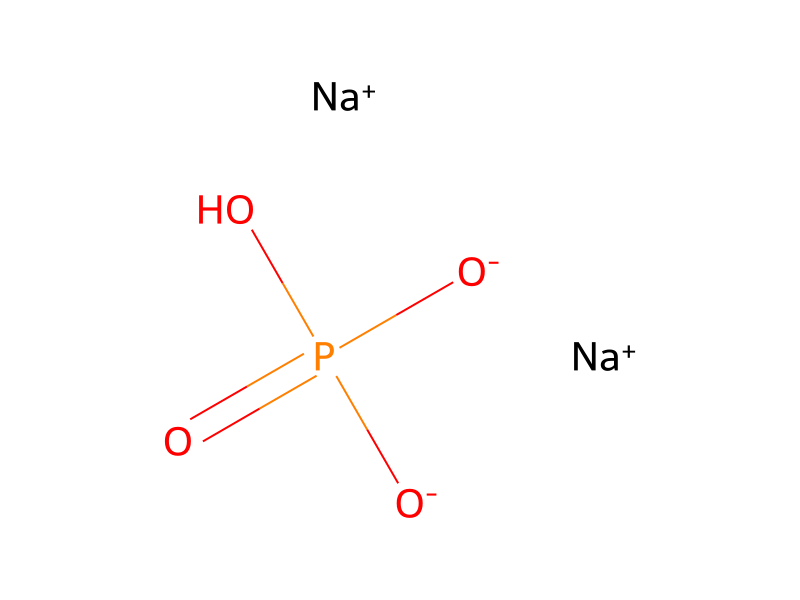
Product 2

Reagents, catalysts & solvents 1

Procedure
Disodium hydrogenphosphate (secondary sodium phosphate), Na2HPO4, is a colorless, water-soluble crystalline salt. It exists anyhdrously and with 2 mol (density 2.066 gcm−3, water lost at 95°), 7 mol (density 1.68 gcm−3, melting point 48° with loss of 5 H2O), and 12 mol of water (density 1.52 gcm−3, melting point 35° with loss of 5 H2O); it becomes anhydrous at 100° and when more strongly heated transitions into the diphosphate Na4P2O7. Disodium hydrogenphosphate is produced by the neutralization of phosphoric acid with a soda solution using phenolphthalein as indicator. Dipotassium hydrogenphosphate (secondary or dibasic potassium phosphate), K2HPO4, is an amorphous white salt that is easily soluble in water.
Workup
- custombecomes anhydrous at 100°
Sources & evidence
- ORD record
- ord-2f4b2e6a04c640cdaa5abba2086b4669
- Source dataset
- uspto-grants-2010_10
- Patent number
- US07811076B2
Reaction notes
Loading…