Sodium Carbonate → 4'-Trifluoromethyl-biphenyl-3-carboxylic acid
Reaction equation

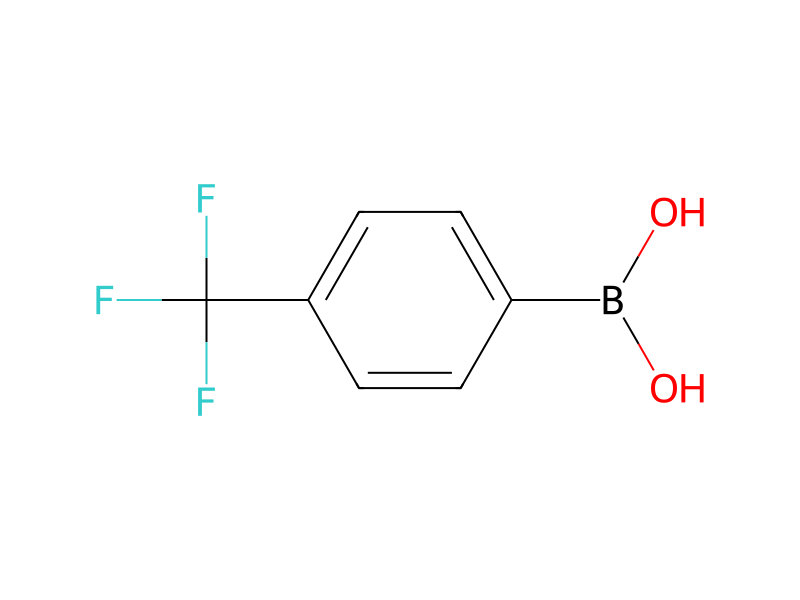
[F:1][C:2]([F:13])([F:12])[C:3]1[CH:8]=[CH:7][C:6](B(O)O)=[CH:5][CH:4]=1.Br[C:15]1[CH:16]=[C:17]([CH:21]=[CH:22][CH:23]=1)[C:18]([OH:20])=[O:19].C([O-])([O-])=O.[Na+].[Na+]>CC(O)C.O.[Pd]>[F:1][C:2]([F:13])([F:12])[C:3]1[CH:8]=[CH:7][C:6]([C:15]2[CH:16]=[C:17]([CH:21]=[CH:22][CH:23]=2)[C:18]([OH:20])=[O:19])=[CH:5][CH:4]=1Participants
6





Conditions
- Temperature
- 70 °C
Procedure
The Suzuki coupling was carried out according to the method of Dyer et al. (2001) Tetrahedron Letters 42: 1765-1767. Commercially available 4-(Trifluoromethyl)phenylboronic acid (15 g, 78.7 mmol) and 3-bromobenzoic acid (15.1 g, 75 mmol) were suspended in 2-propanol:water (1:4, 72 mL). 10% Pd/C (1.5 g) was added followed by aqueous Na2CO3 (39 mL, 20% by wt.). The resulting mixture was heated at 70° C. for 4 hours. The precipitate was filtered and rinsed with 20% aqueous Na2CO3 solution. The filtrate was diluted with water and acidified to pH=2. The white solid was filtered and dried in vacuo. The crude material (2.1) (19.69 g) was used in the next step without further purification.
Workup
- filtrationThe precipitate was filtered
- washrinsed with 20% aqueous Na2CO3 solution
- additionThe filtrate was diluted with water
- filtrationThe white solid was filtered
- customdried in vacuo
- customThe crude material (2.1) (19.69 g) was used in the next step without further purification
Sources & evidence
- ORD record
- ord-d1d6bcefcf0b40bf807b92327a878b84
- Source dataset
- uspto-grants-2010_10
- Patent number
- US07816367B2
Reaction notes
Loading…