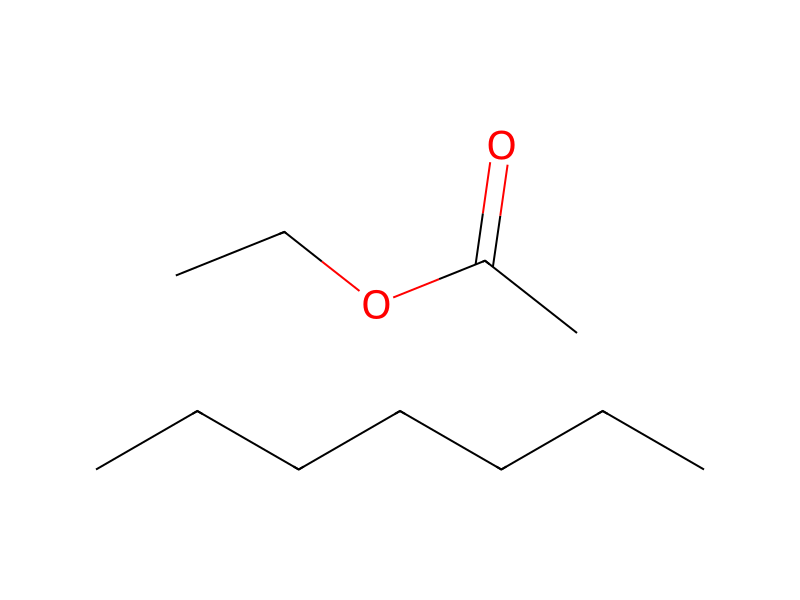
Ethylacetate heptane → 3-Fluoro-2-(3-hydroxypropyl)-6-methoxyphenol
Reaction equation

[F:1][C:2]1[C:7]([CH:8]=O)=[C:6]([OH:10])[C:5]([O:11][CH3:12])=[CH:4][CH:3]=1.CCCCCCC.[C:20](OCC)(=[O:22])[CH3:21]>ClCCl>[F:1][C:2]1[C:7]([CH2:8][CH2:21][CH2:20][OH:22])=[C:6]([OH:10])[C:5]([O:11][CH3:12])=[CH:4][CH:3]=1Participants
Reactant 2

Product 1

Reagents, catalysts & solvents 1

Procedure
To a solution of 4.46 g of 6-fluoro-2-hydroxy-3-methoxybenzaldehyde in 50 ml of dichloromethane there was added 10 g of (triphenyl phosphoranilidene)acetic acid ethyl ester while cooling on ice. After stirring at room temperature for 30 minutes, the reaction mixture was poured into a silica gel column and elution was performed with heptane-ethyl acetate=3:1. The eluate was concentrated under reduced pressure. The residue was dissolved in 100 ml of ethyl acetate, 1 g of 10% palladium-carbon was added, and the mixture was stirred at room temperature for 7 hours under a hydrogen atmosphere. The reaction mixture was filtered through celite, and the filtrate was concentrated under reduced pressure. The residue was dissolved in 100 ml of THF, and then 2 g of lithium borohydride was added while cooling on ice and the mixture was stirred overnight at room temperature. After adding 1N hydrochloric acid to the reaction mixture while cooling on ice, extraction was performed with ethyl acetate. The organic layer was dried over anhydrous magnesium sulfate. The desiccating agent was filtered off and the filtrate was concentrated under reduced pressure. The residue was purified by silica gel column chromatography (ethyl acetate-heptane) to give the title compound (4.78 g) as a solid.
Workup
- temperaturewhile cooling on ice
- additionthe reaction mixture was poured into a silica gel column and elution
- concentrationThe eluate was concentrated under reduced pressure
- dissolutionThe residue was dissolved in 100 ml of ethyl acetate
- addition1 g of 10% palladium-carbon was added
- stirringthe mixture was stirred at room temperature for 7 hours under a hydrogen atmosphere
- filtrationThe reaction mixture was filtered through celite
- concentrationthe filtrate was concentrated under reduced pressure
- dissolutionThe residue was dissolved in 100 ml of THF
- addition2 g of lithium borohydride was added
- temperaturewhile cooling on ice
- stirringthe mixture was stirred overnight at room temperature
- additionAfter adding 1N hydrochloric acid to the reaction mixture
- temperaturewhile cooling on ice, extraction
- dry with materialThe organic layer was dried over anhydrous magnesium sulfate
- filtrationThe desiccating agent was filtered off
- concentrationthe filtrate was concentrated under reduced pressure
- customThe residue was purified by silica gel column chromatography (ethyl acetate-heptane)
Sources & evidence
- ORD record
- ord-ea89998bd47f4f3f8148f106a775b577
- Source dataset
- uspto-grants-2010_10
- Patent number
- US07816522B2
Reaction notes
Loading…