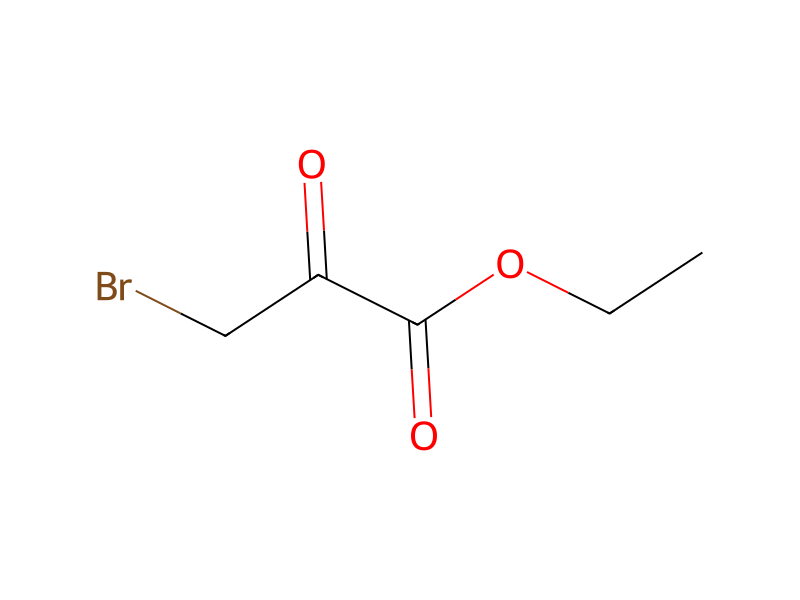
Ethyl bromopyruvate → N-[4-(Ethoxycarbonyl)-1,3-thiazol-2-yl]hexopyranosylamine--hydrogen bromide (1/1)
Reaction equation

[Br:1][CH2:2][C:3](=O)[C:4]([O:6][CH2:7][CH3:8])=[O:5].[C@@H:10]1([NH:21][C:22]([NH2:24])=[S:23])[O:18][C@H:17]([CH2:19][OH:20])[C@@H:15]([OH:16])[C@H:13]([OH:14])[C@H:11]1[OH:12]>C(O)C>[BrH:1].[C@@H:10]1([NH:21][C:22]2[S:23][CH:2]=[C:3]([C:4]([O:6][CH2:7][CH3:8])=[O:5])[N:24]=2)[O:18][C@H:17]([CH2:19][OH:20])[C@@H:15]([OH:16])[C@H:13]([OH:14])[C@H:11]1[OH:12]Participants
4
Reactant 2

Product 1

Reagents, catalysts & solvents 1

Procedure
Ethyl bromopyruvate (8.99 g., 0.047 mole) was added to a suspension of N-β-D-glucopyranosylthiourea (10 g., 0.042 mole) in 120 ml. of hot ethanol, and the reaction was completed by heating 30 minutes. During the heating, the mixture became a clear solution. The reaction solution was evaporated to dryness in vacuo. The residue was crystallized from ethanol and acetone, filtered, and dried at room temperature in vacuo, yielding 16.03 g. (91.9%); white powder; m.p. 162°-163°(dec.).
Workup
- temperatureby heating 30 minutes
- customThe reaction solution was evaporated to dryness in vacuo
- customThe residue was crystallized from ethanol and acetone
- filtrationfiltered
- customdried at room temperature in vacuo
- customyielding 16.03 g
Sources & evidence
- ORD record
- ord-7eca43226cbf4680be77ee7ecbcefe63
- Source dataset
- uspto-grants-1983_01
- Patent number
- US04367226
Reaction notes
Loading…