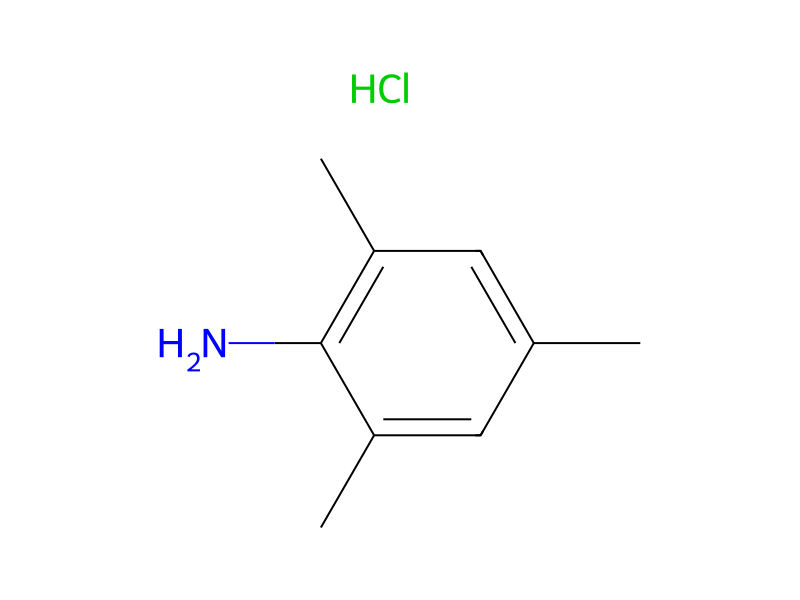
2,4,6-Trimethylaniline → Benzenamine, 2,4,6-trimethyl-, hydrochloride (1:1)
Reaction equation

[Cl:1]C(C)C[NH:4][C:5]1[C:10]([CH3:11])=[CH:9][C:8]([CH3:12])=[CH:7][C:6]=1[CH3:13].CC1C=C(C)C=C(C)C=1N>[I-].[K+].C(OCC)C>[ClH:1].[CH3:13][C:6]1[CH:7]=[C:8]([CH3:12])[CH:9]=[C:10]([CH3:11])[C:5]=1[NH2:4]Participants
Reactant 2


Product 1
Reagents, catalysts & solvents 2


Procedure
32.75 g (0.155 moles) of N-(β-chloropropyl)-2,4,6-trimethyl-aniline, prepared as indicated in point (b) above, are reacted with 41.8 g (0.31 moles) of 2,4,6-trimethyl-aniline in the presence of 1.0 g (6 mmoles) of potassium iodide as described in Example 3, Method (b), point (b). The resulting mixture is admixed with 50 ml of diethyl ether, the separated precipitate is filtered off, washed with diethyl ether and dried. 24.8 g (46.6%) of 2,4,6-trimethylaniline hydrochloride are obtained. The filtrate is acidified with isopropanolic hydrochloric acid (acid content: about 15 g/100 ml), and the resulting mixture is maintained at 0° to +5° for 2 hours. The separated precipitate is filtered off, washed with cold isopropanol, and dried. 50.3 g (84.8%) of 1,2-bis(2',4',6'-trimethylphenyl-amino)-propane dihydrochloride are obtained; m.p.: 172°-173° C. The base is liberated from this salt as described in Example 3, Method (b), point (b), and is separated from the reaction mixture by chloroform extraction.
Workup
- filtrationthe separated precipitate is filtered off
- washwashed with diethyl ether
- customdried
Sources & evidence
- ORD record
- ord-de23ea10ee8249e0b1d9f119d5f35b34
- Source dataset
- uspto-grants-1983_01
- Patent number
- US04369325
Reaction notes
Loading…