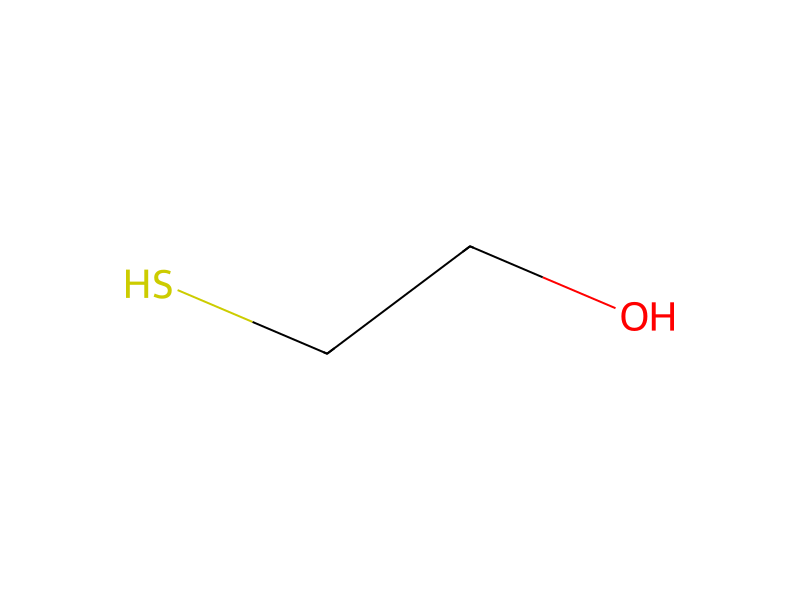
2-Mercaptoethanol → HCID 13885751, compound
Reaction equation

[SH:1][CH2:2][CH2:3][OH:4].C[O-].[Na+].[C:8]([C:11]1[CH:21]=[CH:20][C:14]([O:15][CH2:16][CH2:17][CH2:18]Br)=[C:13]([CH2:22][CH2:23][CH3:24])[C:12]=1[OH:25])(=[O:10])[CH3:9]>>[C:8]([C:11]1[CH:21]=[CH:20][C:14]([O:15][CH2:16][CH2:17][CH2:18][S:1][CH2:2][CH2:3][OH:4])=[C:13]([CH2:22][CH2:23][CH3:24])[C:12]=1[OH:25])(=[O:10])[CH3:9]Participants
4



Procedure
4.68 g. (60 mMole) 2-mercaptoethanol are stirred for 10 minutes at ambient temperature with 60 ml. 1M sodium methylate solution. Subsequently, 9.39 g. 3-(4-acetyl-3-hydroxy-2-propylphenoxy)-propyl bromide are added thereto and the reaction mixture is boiled under reflux for 5 hours. The reaction mixture is thereafter evaporated and the residue mixed with water and ethyl acetate. The ethyl acetate phase is successively shaken with 2M aqueous sodium hydroxide solution and with 2M hydrochloric acid and then dried and evaporated. After recrystallising the residue from diethyl ether/ligroin, there are obtained 6.4 g. (68% of theory) of the title compound; m.p. 72°-74° C.
Workup
- temperatureunder reflux for 5 hours
- customThe reaction mixture is thereafter evaporated
- additionthe residue mixed with water and ethyl acetate
- customdried
- customevaporated
- customAfter recrystallising the residue from diethyl ether/ligroin, there
- customare obtained 6.4 g
Sources & evidence
- ORD record
- ord-288619533ac141d598d088d08ccec5c9
- Source dataset
- uspto-grants-1990_03
- Patent number
- US04906666
Reaction notes
Loading…