Phosphoric Acid → Phosphoric Acid
Reaction equation

[P].[P:2]([O-:6])([O-:5])([O-:4])=[O:3].[P:7]([O-:11])([O-:10])([O-:9])=[O:8].[Al+3:12].P(=O)(O)(O)O>CO>[P:2]([O-:6])([O-:5])([O-:4])=[O:3].[Al+3:12].[P:7](=[O:8])([OH:11])([OH:10])[OH:9].[Al:12]Participants
Reactant 4

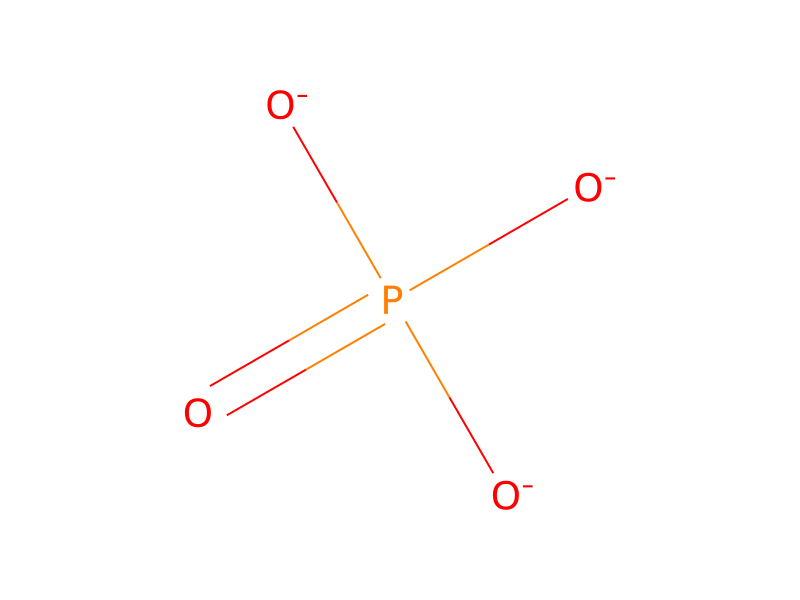


Product 3

Reagents, catalysts & solvents 1
Procedure
Phosphorous stabilization is well known in the art, and more details of the technique are given in the following patents. U.S. Pat. No. 3,911,041, which is incorporated by reference, teaches conversion of methanol and ethers over phosphorous stabilized zeolites. U.S. Pat. No. 3,972,832, which is incorporated by reference, teaches and claims a composition of matter of a phosphorus containing, shape selective zeolite having at least 0.78 wt % phosphorus incorporated with the crystal structure. U.S. Pat. No. 4,044,065, claims conversion of aliphatics over phosphorus containing shape selective zeolites. U.S. Pat. Nos. 4,356,338 and 4,423,266 teach decreasing catalyst coking, and extending catalyst life, by pretreatment of the catalyst with steam and/or a phosphorus-containing compound. P-ZSM-5/Al2O3 has a much-reduced coking rate, as compared to H-ZSM-5/Al2O3. U.S. Pat. No. 4,590,321, which is incorporated by reference, claims conversion of feeds comprising C2 to C12 alkanes or alkenes at 200 to 700° C. over a phosphorus stabilized zeolite made by impregnating with phosphate ions, then calcining to convert phosphate ions to an oxide of phosphorus. U.S. Pat. No. 5,194,412 provides improved catalytic compositions that include a zeolite and aluminum phosphate. U.S. Pat. No. 3,354,096 describes zeolite containing adsorbent and catalyst compositions that contain a phosphate-binding agent to improve physical strength. U.S. Pat. No. 3,649,523 describes hydrocracking catalysts which comprise a zeolite and an aluminum phosphate gel matrix. U.S. Pat. Nos. 4,454,241, 4,465,780, 4,498,975 and 4,504,382 describe zeolite catalysts that are prepared from clay which are further modified by the addition of a phosphate compound to enhance catalytic activity. U.S. Pat. Nos. 4,567,152, 4,584,091, 4,629,717 and 4,692,236 describe zeolite containing catalytic cracking catalysts that include phosphorus-containing alumina. U.S. Pat. Nos. 4,605,637, 4,578,371, 4,724,066 and 4,839,319 describe phosphorus and aluminum phosphate modified zeolites such as ZSM-5, Beta and ultrastable Y that are used in the preparation of catalytic compositions, including catalytic cracking catalysts. U.S. Pat. No. 4,765,884 and U.S. Pat. No. 4,873,211 describe the preparation of cracking catalysts which consist of a zeolite and a precipitated aluminum phosphate gel matrix. U.S. Pat. No. 5,521,133 relates to microspheres produced by spray drying clay slurries and calcining the product to form attrition-resistant microspheres. More particularly, this invention relates to the addition of phosphoric acid to clay in a novel manner, i.e., injecting the acid into dispersed kaolin slurry immediately before spray drying to improve properties of the microspheres. U.S. Pat. No. 5,190,902 utilizes the addition of phosphoric acid (or other phosphate compounds) with kaolin clay in a spray drying process to produce spray-dried microspheres, which are then calcined. In some formulation zeolite particles are present in the spray dryer feed. The process is carried out in one of two basic ways. In one, the slurry of clay particles is brought to a low pH, e.g., 1.0 to 3.0 before being mixed with a source of phosphorus, followed by spray drying. In the other, the clay slurry is brought to a high pH level (e.g., 10 to 14) before mixing with phosphate-containing compound. According to the teachings of this patent, use of these pH ranges is necessary for the production of particles with superior attrition resistance. Similarly, U.S. Pat. No. 5,231,064, and U.S. Pat. No. 5,348,643, both describe formation of a cracking catalyst by spray drying a slurry of zeolite with a slurry of clay treated with a phosphorus source at a pH less than 3. Sufficient water is added to bring the combined slurries to a low solids content of 25%. The use of aluminum phosphates as a binder and hardening agent is well known in the ceramics industry (F. J. Gonzalez and J. W. Halloran Ceran. Bull 59(7), 727 (1980)). This usually involves addition of alumina to the ceramic mix, followed by treatment with phosphoric acid, curing and firing. Similarly, the hardening of aluminous masses such as those composed of bauxite or kaolin clay by incorporation of phosphoric acid followed by heat treatment also is known. The product of this treatment is apparently an aluminum phosphate that can act as a binder. An aluminum phosphate formed by interaction of phosphoric acid solution with an aluminum salt solution has been used to bind zeolite and clay in a cracking catalyst composition (U.S. Pat. No. 5,194,412).
Workup
- customat 200 to 700° C.
- custom5,194,412 provides improved catalytic compositions that
- customare prepared from clay which
- additioncontaining alumina
- customare used in the preparation of catalytic compositions
- customthe preparation of cracking catalysts which
- custom5,521,133 relates to microspheres produced by spray
- customdrying clay slurries
- customto form attrition-resistant microspheres
- customdrying
- additionthe addition of phosphoric acid (or other phosphate compounds) with kaolin clay in a spray
- customdrying process
- customto produce
- customspray-dried microspheres, which
- additionbefore being mixed with a source of phosphorus
- customdrying
- additionbefore mixing with phosphate-
- additioncontaining compound
- dry with material5,348,643, both describe formation of a cracking catalyst by spray drying a slurry of zeolite with a slurry of clay
- additiontreated with a phosphorus source at a pH less than 3
- additionSufficient water is added
- additionThis usually involves addition of alumina to the ceramic mix
- temperatureby heat treatment
Sources & evidence
- ORD record
- ord-8a57ba95344c4c819bf31833e24da07e
- Source dataset
- uspto-grants-2003_09
- Patent number
- US06613710B2
Reaction notes
Loading…