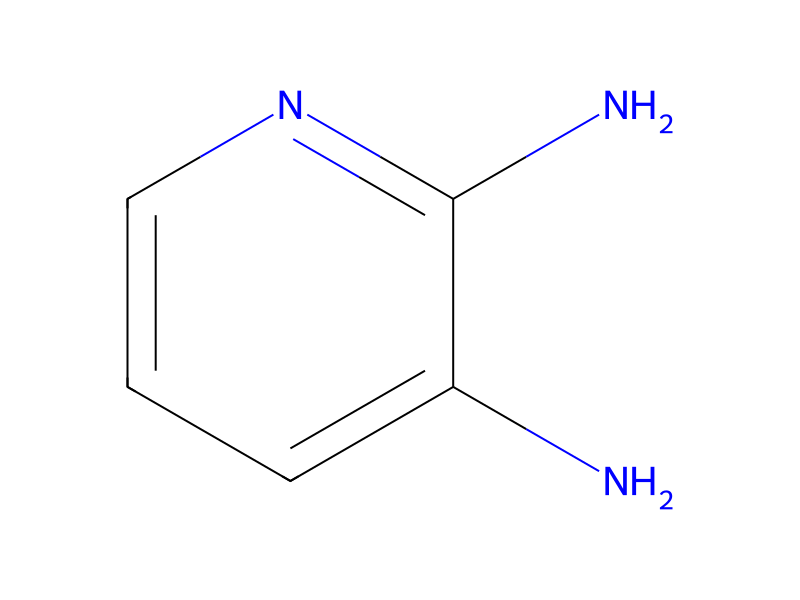
2,3-Diaminopyridine → HCID 22997465, compound
Reaction equation

[NH2:1][C:2]1[C:7]([NH2:8])=[CH:6][CH:5]=[CH:4][N:3]=1.[CH2:9]([O:11][C:12](=[O:22])[CH:13](Br)[C:14](=O)[C:15]([O:17][CH2:18][CH3:19])=[O:16])[CH3:10].C(=O)([O-])[O-].[Na+].[Na+]>COCCOC>[NH2:8][C:7]1[C:2]2[N:3]([C:14]([C:15]([O:17][CH2:18][CH3:19])=[O:16])=[C:13]([C:12]([O:11][CH2:9][CH3:10])=[O:22])[N:1]=2)[CH:4]=[CH:5][CH:6]=1Participants
5
Reactant 3


Product 1

Reagents, catalysts & solvents 1

Procedure
A solution of 2,3-diaminopyridine (13.1 g, 0.12 mol) , 2-bromo-3-oxo-succinic acid diethyl ester (31 g, 0.12 mol) and sodium carbonate (13.2 g, 0.12 mol) in 1,2-dimethoxyethane (200 ml) was refluxed for 20 h. The solvent was evaporated under reduced pressure and the residue was suspended in methylene chloride and filtrated through silica gel. The filtrate was evaporated under reduced pressure to give 10.9 g (33%) of the title compound as an oil.
Workup
- customThe solvent was evaporated under reduced pressure
- filtrationfiltrated through silica gel
- customThe filtrate was evaporated under reduced pressure
Sources & evidence
- ORD record
- ord-5199ad6fb6e44ecf92a5ac7cdd3d4453
- Source dataset
- uspto-grants-2003_09
- Patent number
- US06613775B1
Reaction notes
Loading…