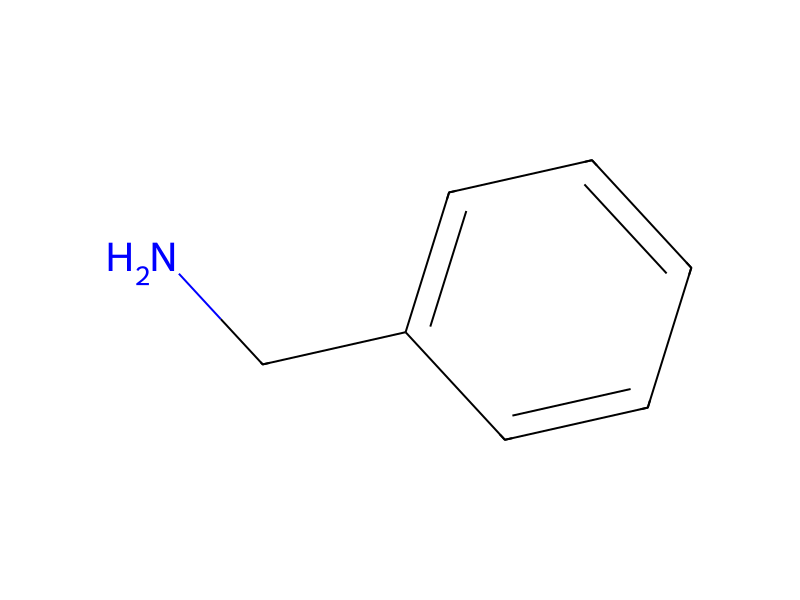
Benzylamine → HCID 9794807, compound
Reaction equation

Cl[CH2:2][CH2:3][CH2:4][O:5][C:6]1[CH:7]=[N:8][CH:9]=[CH:10][CH:11]=1.[CH2:12]([NH2:19])[C:13]1[CH:18]=[CH:17][CH:16]=[CH:15][CH:14]=1>CO.O>[CH2:12]([NH:19][CH2:2][CH2:3][CH2:4][O:5][C:6]1[CH:7]=[N:8][CH:9]=[CH:10][CH:11]=1)[C:13]1[CH:18]=[CH:17][CH:16]=[CH:15][CH:14]=1Participants
Reactant 2

Product 1

Reagents, catalysts & solvents 2


Conditions
- Temperature
- 120 °C
Procedure
The 3-chloro-1-(3-pyridyloxy)propane (0.65 g, 3.78 mmol) was dissolved in methanol (20 mL) and added to a mixture of benzylamine (13.5 mL) in water (20 mL) in a heavy-walled glass pressure-tube apparatus. The tube was sealed and the mixture was stirred and heated at 120° C. (oil bath temperature) for 3 h. After cooling, the mixture was concentrated by rotary evaporation, and saturated NaCl solution (25 mL) was added to the residue. The mixture was acidified to pH 1 with 10% HCl solution and extracted with CHCl3 (2×35 mL) to remove impurities. The aqueous phase was basified to pH 10 with 10% NaOH solution, and the mixture was extracted with chloroform (4×50 mL). The combined chloroform extracts were dried (MgSO4), filtered, and concentrated by rotary evaporation to a residue that was dried briefly under high vacuum to give a brown oil. The oil was concentrated by vacuum distillation to remove excess benzylamine (bp 85° C. at 15 mm Hg). The remaining residue (0.483 g) was purified by column chromatography on silica gel (25 g) eluting with CH3OH—NH4OH (50:1, v/v). Fractions containing the product (Rf 0.39) were combined and concentrated on a rotary evaporator. The residue was re-chromatographed on silica gel (10 g). Fractions containing the product were combined and concentrated on a rotary evaporator. The residue was dissolved in CHCl3 and the CHCl3 solution was dried (MgSO4), filtered, and concentrated by rotary evaporation to a residue that was dried briefly under high vacuum to give 20 mg (2.2%) of a light-brown oil. The compound exhibits a Ki of 3000 nM. The compound exhibits neurotransmitter release of 29 percent.
Workup
- customThe tube was sealed
- temperatureAfter cooling
- concentrationthe mixture was concentrated by rotary evaporation, and saturated NaCl solution (25 mL)
- additionwas added to the residue
- extractionextracted with CHCl3 (2×35 mL)
- customto remove impurities
- extractionthe mixture was extracted with chloroform (4×50 mL)
- dry with materialThe combined chloroform extracts were dried (MgSO4)
- filtrationfiltered
- concentrationconcentrated by rotary evaporation to a residue that
- customwas dried briefly under high vacuum
- customto give a brown oil
- concentrationThe oil was concentrated by vacuum distillation
- customto remove excess benzylamine (bp 85° C. at 15 mm Hg)
- customThe remaining residue (0.483 g) was purified by column chromatography on silica gel (25 g)
- washeluting with CH3OH—NH4OH (50:1
- additionFractions containing the product (Rf 0.39)
- concentrationconcentrated on a rotary evaporator
- customThe residue was re-chromatographed on silica gel (10 g)
- additionFractions containing the product
- concentrationconcentrated on a rotary evaporator
- dissolutionThe residue was dissolved in CHCl3
- dry with materialthe CHCl3 solution was dried (MgSO4)
- filtrationfiltered
- concentrationconcentrated by rotary evaporation to a residue that
- customwas dried briefly under high vacuum
Sources & evidence
- ORD record
- ord-555ffcaf1360417a897c40fa1a54ece5
- Source dataset
- uspto-grants-2003_09
- Patent number
- US06627648B1
Reaction notes
Loading…