1,3-Propanediol → 3-({6-Chloro-2-[(2,3-difluorobenzyl)thio]pyrimidin-4-yl}oxy)propan-1-ol
Reaction equation

Cl[C:2]1[CH:7]=[C:6]([Cl:8])[N:5]=[C:4]([S:9][CH2:10][C:11]2[CH:16]=[CH:15][CH:14]=[C:13]([F:17])[C:12]=2[F:18])[N:3]=1.[CH2:19]([OH:23])[CH2:20][CH2:21][OH:22].[H-].[Na+]>C1COCC1>[Cl:8][C:6]1[N:5]=[C:4]([S:9][CH2:10][C:11]2[CH:16]=[CH:15][CH:14]=[C:13]([F:17])[C:12]=2[F:18])[N:3]=[C:2]([O:22][CH2:21][CH2:20][CH2:19][OH:23])[CH:7]=1Participants
5
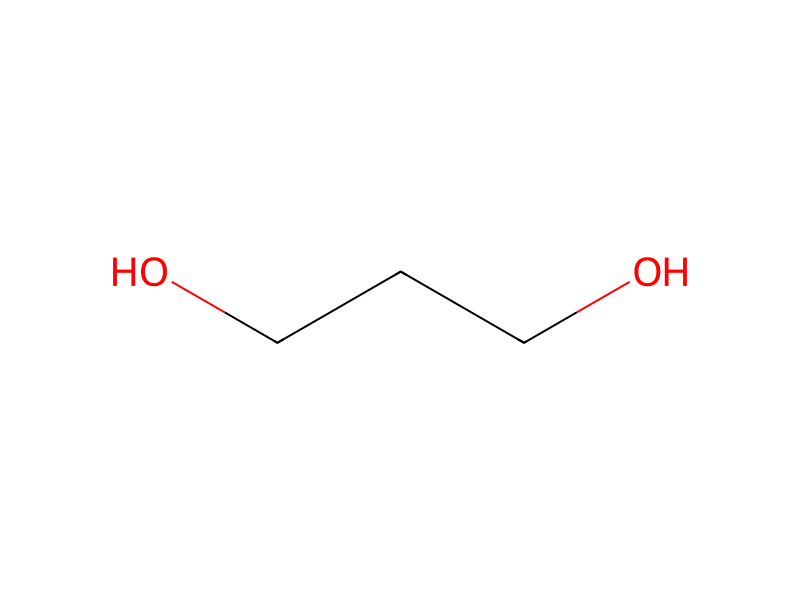




Procedure
To a solution of 4,6-dichloro-2-[(2,3-difluorobenzyl)thio]pyrimidine (the product of example 1 step ii), 3 g) and propane-1,3-diol (1.1 g) in THF (50 ml) was added NaH (390 mg) slowly and the reaction was then allowed to stir at room temperature for 18 h. The reaction mixture was then partitioned between DCM (150 ml) and H2O (100 ml). The organics were separated and the aqueous layer was re-extracted with DCM (2×150 ml). Organics were combined, dried (MgSO4) and reduced in vacuo to give the subtitle compound as a yellow oil. Yield 2.9 g
Workup
- customThe reaction mixture was then partitioned between DCM (150 ml) and H2O (100 ml)
- customThe organics were separated
- extractionthe aqueous layer was re-extracted with DCM (2×150 ml)
- dry with materialdried (MgSO4)
Sources & evidence
- ORD record
- ord-31ee074b979c4d24acce1a72da86b76f
- Source dataset
- uspto-grants-2010_11
- Patent number
- US07838675B2
Reaction notes
Loading…