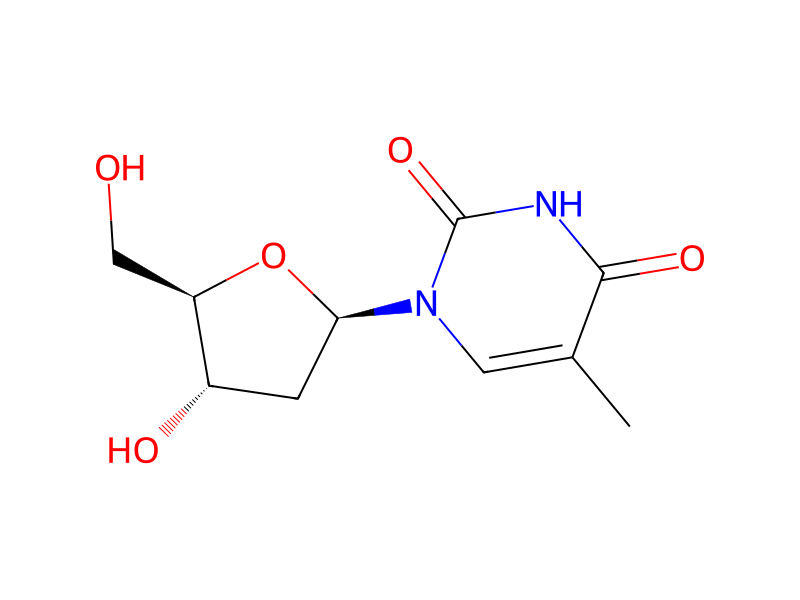
Thymidine → HCID 15613767, compound
Reaction equation

[C@@H:1]1([N:9]2[CH:17]=[C:15]([CH3:16])[C:13](=[O:14])[NH:12][C:10]2=[O:11])[O:8][C@H:5]([CH2:6][OH:7])[C@@H:3]([OH:4])[CH2:2]1.ClCCl.[C:21](Cl)([O:23][CH2:24][CH:25]1[C:37]2[C:32](=[CH:33][CH:34]=[CH:35][CH:36]=2)[C:31]2[C:26]1=[CH:27][CH:28]=[CH:29][CH:30]=2)=[O:22]>N1C=CC=CC=1>[C:21]([O:7][CH2:6][C@H:5]1[O:8][C@@H:1]([N:9]2[CH:17]=[C:15]([CH3:16])[C:13](=[O:14])[NH:12][C:10]2=[O:11])[CH2:2][C@@H:3]1[OH:4])([O:23][CH2:24][CH:25]1[C:26]2[C:31](=[CH:30][CH:29]=[CH:28][CH:27]=2)[C:32]2[C:37]1=[CH:36][CH:35]=[CH:34][CH:33]=2)=[O:22]Participants
Reactant 3


Product 1

Reagents, catalysts & solvents 1

Procedure
Thymidine (10 mmol) was dried by coevaporation with dry pyridine (2×30 ml), re-dissolved in dry pyridine (50 ml) and cooled using an acetone/carbon dioxide bath to a temperature of −20° C. The thymidine solution was magnetically stirred and a dichloromethane solution of FMOC-Cl (12 mmol, 1.2 eq. in 20 ml DCM) was added over a period of 60 minutes. The reaction mixture was warmed to room temperature and stirred for additional 60 minutes. The reaction mixture was partitioned between saturated sodium hydrogen carbonate (250 ml) and dichloromethane (3×100 ml). The organic phase was saved, combined, evaporated and dried by coevaporation with toluene (2×50 ml) forming an oily residue. A pure product was crystallized from the oily residue using dichloromethane (30 ml) and benzene (50 ml) as solvent. Yield 76%—white crystals.
Workup
- temperaturecooled
- customto a temperature of −20° C
- customThe reaction mixture was partitioned between saturated sodium hydrogen carbonate (250 ml) and dichloromethane (3×100 ml)
- customevaporated
- dry with materialdried by coevaporation with toluene (2×50 ml)
- customforming an oily residue
- customA pure product was crystallized from the oily residue
Sources & evidence
- ORD record
- ord-ca3eada4ea2c4dadb70232871aa6cba8
- Source dataset
- uspto-grants-2007_10
- Patent number
- US07279563B2
Reaction notes
Loading…