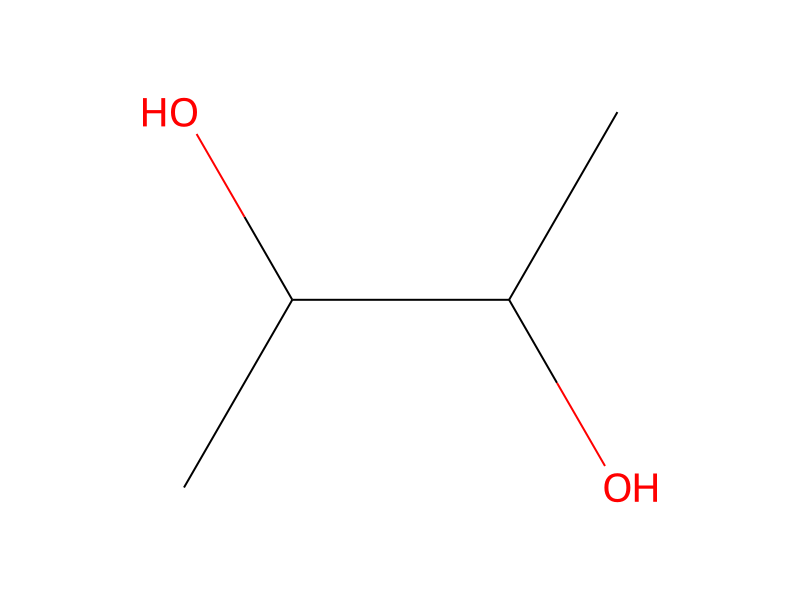
2,3-Butanediol → 2,3-Butanediol
Reaction equation

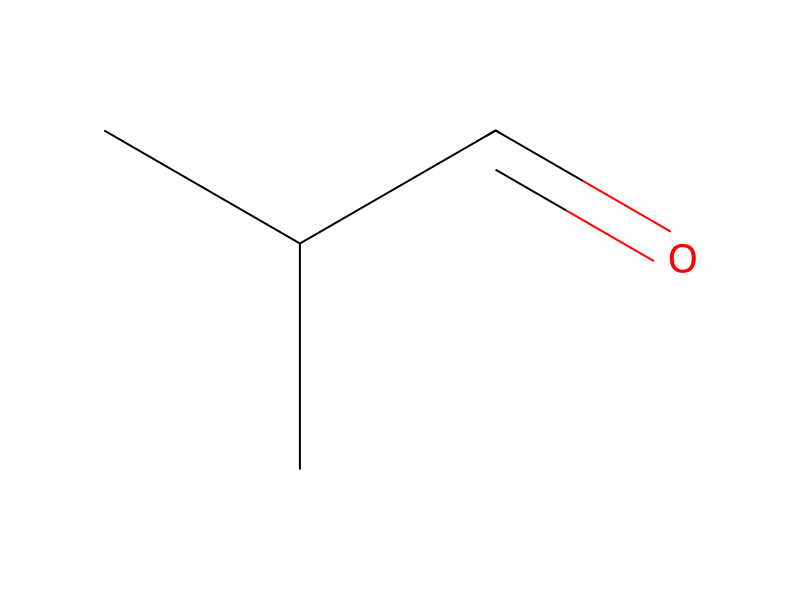
[CH3:1][CH:2]([OH:6])[CH:3]([OH:5])[CH3:4].S(=O)(=O)(O)O.P(=O)(O)(O)O.[CH3:17]C(=O)CC>>[CH:2](=[O:6])[CH:3]([CH3:17])[CH3:4].[CH3:1][CH:2]([OH:6])[CH:3]([OH:5])[CH3:4]Participants



Procedure
The dehydration of 2,3-butanediol has previously been carried out by means of heterogeneous and homogeneous catalysis. Aluminosilicates (A. N. Bourns, R. V. V. Nicholls, Can. J. Res. B 1946-1947, 24-25, 80 ff) and Nafion®-H (I. Bucsi, A. Molnár, M. Bartók, Tetrahedron 1994, 50, 27, 8195 ff) were used as heterogeneous catalysts. Sulfuric acid (A. C. Neish, V. C. Haskell, F. J. MacDonald, Can. J. Res. B 1945, 23, 281 ff) or phosphoric acid (E. R. Alexander, D. C. Dittmer, J. Am. Chem. Soc. 1951, 73, 1665 ff) were used for homogeneously catalysed dehydration. In all experiments, 2-butanone and isobutyraldehyde, and also its acetal with 2,3-butanediol, were obtained in varying proportions. Bourns was able to obtain 2-butanone in 85% yield in a gas phase reaction at 225° C. over aluminosilicate. The yield declined at higher temperatures, while above 450° C. only gaseous decomposition products were formed. Bucsi likewise achieved a selectivity for 2-butanone of 83% with almost complete conversion, by heterogeneous catalysis over Nafion®-H catalysts, while the formation of isobutyraldehyde could be almost completely eliminated (S=3%). Neish investigated the kinetics of dehydration to 2-butanone with addition of 3-20% (g g−1) sulfuric acid. For the rac-meso starting materials (isomeric mixture of (R,R)- and (S,S)- and meso-2,3-butanediol), distillation with 85% phosphoric acid results in a combined yield of 2-butanone and isobutyraldehyde of 59%. The use of high acid concentrations, however, is accompanied by increased corrosion of the reactor. Furthermore, an additional neutralization is required during workup.
Sources & evidence
- ORD record
- ord-958e7f697b9d487a9bd52efdd2c58d11
- Source dataset
- uspto-grants-2014_03
- Patent number
- US08664449B2
Reaction notes
Loading…